
From sand to silicone
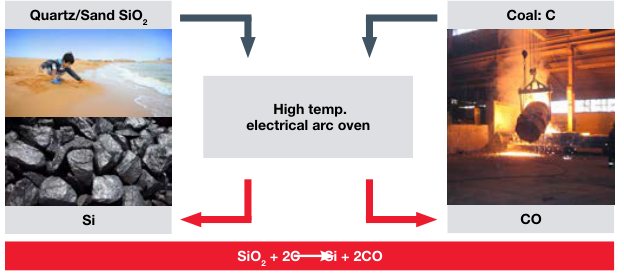
The main raw material needed for the production of silicone is sand (SiO₂). Sand is reduced to silicon metal in a high temperature electrical arc oven using coal.
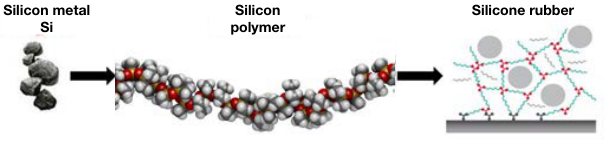
The silicon metal is subsequently polymerized to obtain polydimethylsiloxane, which has a backbone made of Si-O bonds with two methyl groups on each Si atom. This block is repeated to obtain polymers of different lengths and viscosity. The extremities of the helicoidal polymer chain are terminated with different types of functional groups which impart specific properties to the polymer. In a next step the polymer is formulated into a sealant, adding various elements such as adhesion promotors to develop adhesion on substrates, fillers such as calcium carbonate (CaCO₃) to provide mechanical properties such as strength and tear resistance and of course crosslinking elements to connect the polymer chains into a three-dimensional structure, to produce the silicone rubber typically used in sealing applications.
Silicone under fire exposure
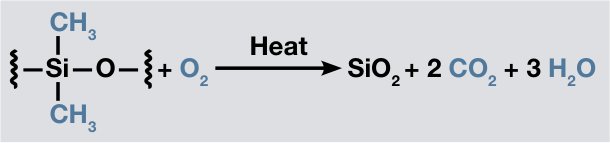
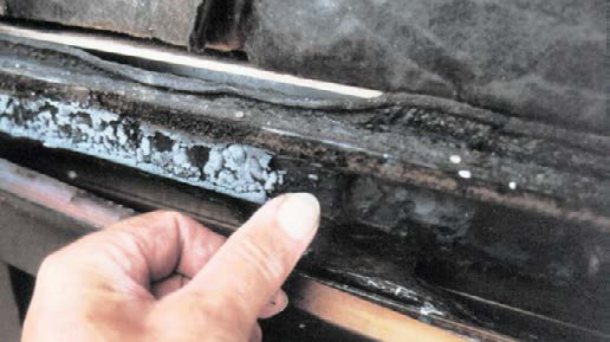
During a fire, the cured silicone is exposed to a combination of heat and oxygen. This will eventually result in the re-oxidization of the silicon atom in the polymer into silica (SiO₂), the original raw material. This can be observed through the formation of a silica char on the silicone that has been exposed to heat and oxygen. This silica char will be white, even in the case of a black silicone, as the carbon black pigment will oxidize into CO₂. A by-product of this reaction is water vapor.
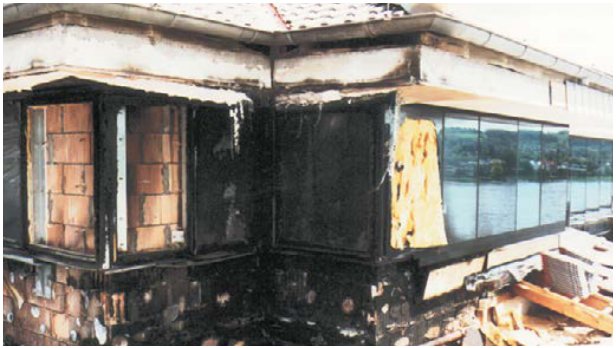
The excellent performance of the DOWSIL™ Silicone Sealants can be observed in a real fire case. The images below show a low-rise residential building with silicone bonded glazed units. An external fire started in the corner of the building. This type of fire can reach 600°C. The glazed units broke due to the thermal shock but the glass shards remained bonded on the aluminium frame. The silicone charred and a white crust was observed. Underneath the silica char, the silicone still maintained adhesion to the frame.
More technical resources
For supply, quotations and technical questions on DOWSIL™ fire rated sealants, contact us. Source: Dow technical manual (Form No. 62-2233-01-0325 S2D, © 2025 The Dow Chemical Company).
sales@kconstrade.comWhatsApp