
Application guidelines
The following application guidelines for linear joints or penetration seal systems for new building construction or in sealing and upgrading the capabilities of older existing building structures is provided for the convenience of the architect/specifier. The followed application guidelines can be incorporated in the detailed specification covering application and quality control procedures of the selected seal system installer. Any substantial deviations from this manual can be referred to by the manufacturer or its representative.
The following guidelines focus on specific information related to the application of DOWSIL™ Fire Rated Silicones which is different to the general rules provided in the Dow Building Envelope Weatherproofing Manual EMEAI. Please refer to this manual for information related to surface preparation (e.g. cleaning, priming), joint shaping and other aspects such as testing in the Dow laboratory. Please contact your local Technical Specialist for further information related to these aspects.
General observations
Materials
- Supporting construction: walls and floors made of new concrete, or cementitious substrates, should be at least 7–28 days old and have a moisture content not exceeding 5%. Laitance deposits are best removed by compressed air, light grit blasting or grinding. To determine the need to clean new concrete, use a clean cloth or finger to pass on the substrates to which adhesion needs to be developed. Repeat the cleaning procedure until the cloth/finger shows no residual dust or dirt.
- Mineral fiber board, mineral fiber matting, and mineral fiber putty: forming and damming materials used to contain the liquid silicone prior to and during curing: fire tested and functionally approved forming materials can be left in place to become an integral part of the seal. To form a good seal, fire stops generally need to be compressed and hence the width of this element must be sufficient to ensure adequate compression, allowing for construction tolerances. Tolerances can occur because the gap between the facade and the structure is greater than anticipated or the fire stop is cut smaller than required, or because the façade bows away from the structure. Potential movements should be evaluated and due allowance made. Compression should occur in the direction of building movement to allow expansion as joints expand. The amount of compression required depends on the nature of the fire stop materials and should be as required by the fire stop manufacturer. Fire stops may be supplied as pre-cut strips of specified width or may be site cut from slabs. If pre-cut strips are used it may be necessary to have a range of sizes available to allow for variation in the gap width between the floor edge and the facade. Alternatively, strips can be supplied at the upper end of the range likely to be required and trimmed where necessary. If site cut strips are used, allowance for cutting tolerances must be made.
- Plywood sheet, particle board or other combustible forming materials are forming and damming materials used for containment during curing only and must be removed from the final completed seal system.
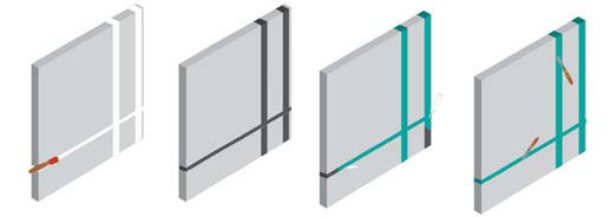
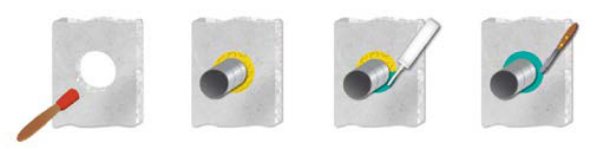
Preparation
Preparation shall include but is not limited to:
- Removing all incidental combustible materials and loose impediments from the penetration or linear joint opening and involved surfaces.
- Removal of free liquids or oil from all involved surfaces and penetration components
- Installation of the specified damming materials to accommodate and help ensure the proper thickness/fire rating requirements and offer containment during foaming where needed
- Removal of all combustible damming materials or materials not intended for the final seal system
Repair
If freshly applied sealant will be applied within 1 hour after cutting the cured compatible sealant, solvent cleaning of the existing silicone surface will not be necessary. Since new silicone sealant fully adheres to cured silicone sealant, no priming is required for silicone sealant to adhere to silicone sealant. If the existing silicone is solvent cleaned, allow the absorbed solvent to evaporate before application of the new sealant.
Material specific observations – gun grade sealants
The application of gun grade sealants such as DOWSIL™ Firestop 700 Sealant (EU), DOWSIL™ Firestop 700 (CN) Sealant, DOWSIL™ 813FR Fire Resistant Silicone and DOWSIL™ 790 Building Sealant, follows the general rules provided in the Dow Building Envelope Weatherproofing Manual EMEAI. No additional application guidelines must be followed to ensure proper performance.
Material specific observations – self leveling sealants
When using a self leveling sealant such as DOWSIL™ Smoke Seal 800SL as a linear joint in floors, it is necessary to use a damming material such as mineral wool. Please refer to the specific instructions in this manual to install these damming materials. The thickness and width of the damming material specified in the test reports needs to be respected to achieve the required fire resistance performance.
After full cure of the sealant, apply light manual pressure along the sealant bonding line, to check good adhesion of the sealant to the substrates. If needed, cut a small piece of cured sealant out to inspect the thickness, following the normal procedure of checking a sealant in situ, as described in the ‘Field adhesion test method’ in the Dow Building Envelope Weatherproofing Manual EMEAI.
Installation steps
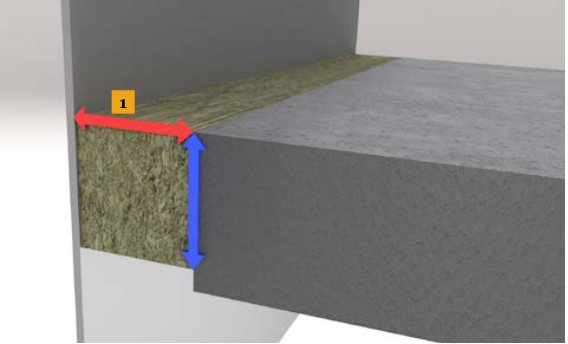
- 1. Insert the mineral wool between wall and floor, making sure the mineral wool is compressed in the width (1) direction to ensure expansion of the mineral wool following the movement of the building.
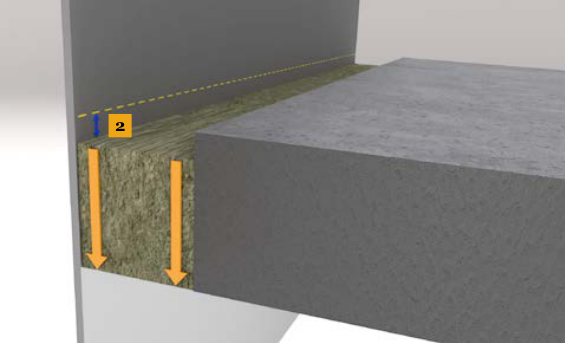
- 2. Push the mineral wool down into the opening, to create the recess space at the required thickness of DOWSIL™ Smoke Seal 800SL (2).
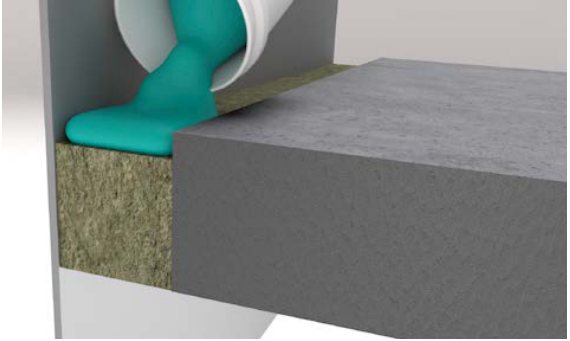
- 3. Clean both sides of wall and floor surfaces prior to pouring DOWSIL™ Smoke Seal 800SL into the formed recessed space. Apply directly from the container (such as pail) or take a small quantity in a cup to facilitate dispensing. The DOWSIL™ Smoke Seal 800SL is a self leveling mono component material which does not require mixing nor tooling.
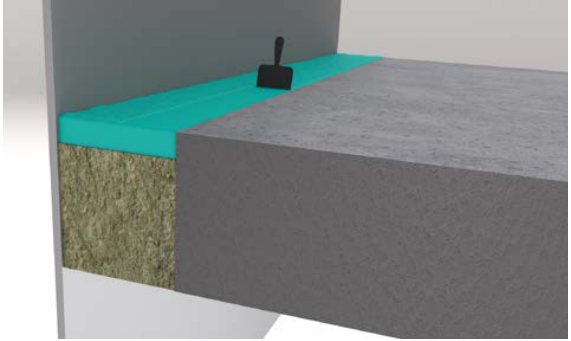
- 4. Where needed, use a spatula to speed up the self leveling of the sealant along the length of the joint. Pay special attention to the corners and edges. It is essential to ensure the sealant fills these completely to ensure good contact and help avoid any risk of smoke leakage.
More technical resources
For supply, quotations and technical questions on DOWSIL™ fire rated sealants, contact us. Source: Dow technical manual (Form No. 62-2233-01-0325 S2D, © 2025 The Dow Chemical Company).
sales@kconstrade.comWhatsApp