
Foam mixing and dispensing equipment
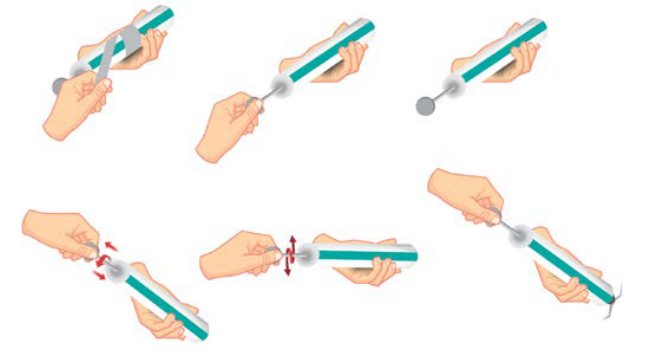
DOWSIL™ 3-6548 RTV Silicone Foam Part A and Part B must be used as supplied by Dow. Other ingredients should not be added unless their specific mixture has been qualified with appropriate testing. Prior to use, containers of DOWSIL™ 3-6548 RTV Silicone Foam Part A and Part B, must be thoroughly agitated by stirring or recirculation in order to re-disperse any solid filler or pigment that may have settled during storage or after standing longer than four hours. The Part A and Part B liquid components of DOWSIL™ 3-6548 Foam should be thoroughly blended in a one to one ratio by either weight or volume. Material may be mixed using suitable pumping systems but can also be hand mixed as illustrated in Figure 20.
- Remove clinch band and discard,
- Pull dasher rod towards the neck of the cartridge. This releases the foil barrier from the mixing head,
- Press cartridge slightly in the area of the clinch band to deform the foil barrier,
- Push dasher rod to the bottom of the cartridge. Rotate dasher rod in a clockwise direction while moving it up and down the cartridge. Be sure to move dasher rod all the way to the top and bottom of the cartridge while mixing. Mix material for 25 strokes, but for no longer than 2 minutes. On the last stroke, the dasher rod should be fully extended.
- Unscrew the dasher rod by gripping the cartridge and turning the dasher rod in an anticlockwise direction.
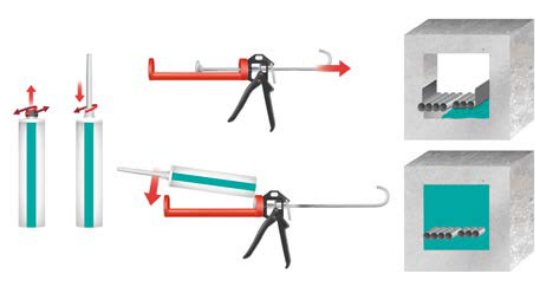
- The foam should be dispensed from the cartridge by placing the dasher rod into the plunger at the base of the cartridge and applying pressure. If using the 600ml cartridge the foam may also be dispensed by using the cartridge in conjunction with an applicator gun.
Specific equipment handling and operating procedures should be as specified in the foam applicators quality control and operating procedures manual. These procedures must include but are not limited to:
- Automatic mixing and dispensing equipment shall be checked a minimum of once daily (prior to start up) to ensure a proper ratio balance and thorough mixing.
- A four step, in-line quality control check (see Table 2) should be made at least once daily, or upon changing to a new lot of material to ensure the performance of both dispensing equipment and foam product prior to installing penetration seals
Quality control
| Check | Requirement |
|---|---|
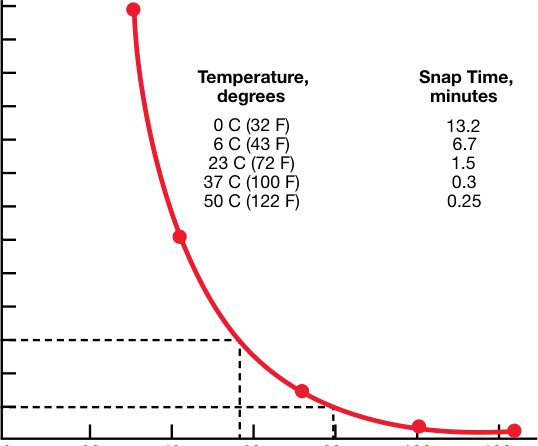
| Snap Time, minutes* | 1–3 |
| Free Foam Density, kg/m3* | 220–320 |
| Color chart comparison | Pass |
| Cell structure chart comparison | Pass |
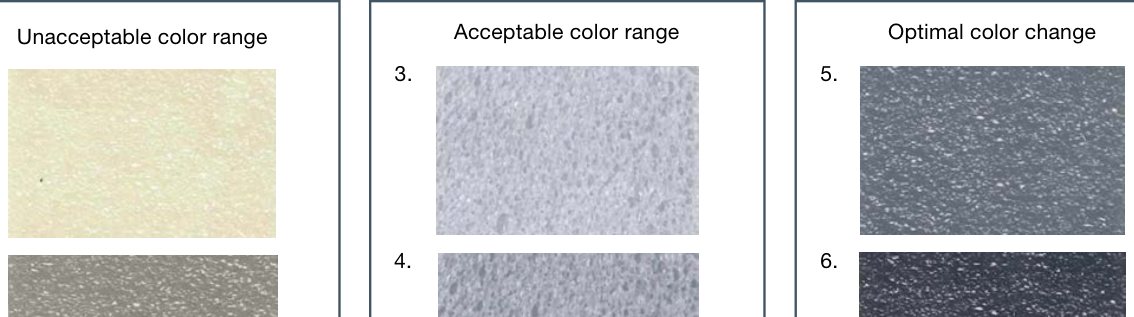
The cured foam color is too light in both samples 1 and 2. If the foam sample is in this color range or is marbled, check your equipment mix ratio. You should also check the original A and B containers and/or the equipment A and B containers of foam to ensure that the fillers and pigments were well dispersed before pouring or mixing. The proper mix ratio and correct dispersion of fillers and pigments result in a more acceptable color range, as illustrated in samples 3 and 4. DOWSIL™ 3-6548 Silicone RTV Foam, when properly mixed and cured, has an optimum color range as shown in samples 5 and 6.
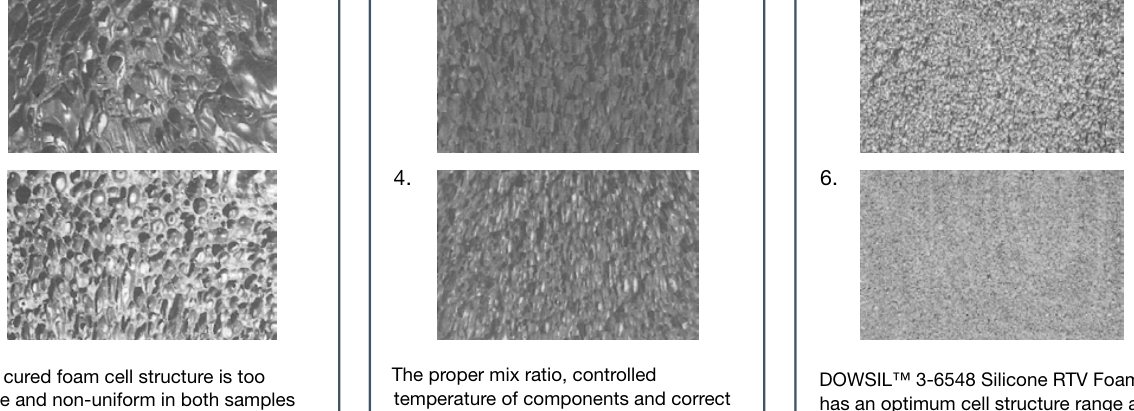
DOWSIL™ 3-6548 Silicone RTV Foam, has an optimum cell structure range as shown in samples 5 and 6. The proper mix ratio, controlled temperature of components and correct snap time result in a more uniform, acceptable cell structure, as illustrated in samples 3 and 4. The cured foam cell structure is too large and non-uniform in both samples 1 and 2. Check the equipment mix ratio. The temperature of the A and B liquid components before and after mixing may also be checked. These temperatures should be between 55°F and 80°F and the snap time between 1 and 2 minutes for optimum results.
Installation
Surface preparation
Priming of surfaces and penetrating components is usually not required since the DOWSIL™ 3-6548 RTV Silicone Foam develops considerable compression and forms a tight mechanical seal when properly installed.
Foam installation
- Properly mixed and dispensed Part A and B liquid mixture should be added (injected) into a properly formed and dammed penetration opening producing a tight foamed-in place penetration seal.
- The DOWSIL™ 3-6548 Foam liquid mixture should not be continuously added for a time interval (shot) that exceeds its measured snap time (three minutes maximum).
- Smaller penetration openings can often be completely foam sealed with one shot applications.
- Larger penetration openings may require several separate shots. Each shot should be given a minimum of fifteen minutes cure time before the next shot is added.
- Sufficient liquid DOWSIL™ 3-6548 Foam mixture should be added to ensure that the penetration opening is completely filled and tightly sealed with the cured foam elastomer.
- After a foam penetration seal has been installed, a minimum of 24 hours is required before any damming forms are removed or the cured foam is trimmed.
- After a minimum of 24 hours, the final penetration seal must be inspected for tightness of seal of the cured foam. Should an area of non-tight seal exist, the affected area should be injected with freshly applied DOWSIL™ 3-6548 Foam liquid mixture and foamed to ensure a tight seal.
Retrofit and maintenance
Changes, modification, repairs to damaged foam, removal of penetrating components, or addition of a new penetrating component can be readily made to existing foam penetration seals. The cured elastomer foam can be easily removed or poked-through and re-foamed and sealed with the injection of freshly mixed DOWSIL™ 3-6548 Foam liquid components.
Clean up
A high-flash mineral spirit solvent is recommended for clean-up of the DOWSIL™ 3-6548 Foam Part A and B liquid components. The cured foam can be cut and trimmed with a sharp knife or blade.
Application and mixing equipment must be in good, clean operating condition. Daily cleaning of the mixing and dispensing gun assemblies is essential.
More technical resources
For supply, quotations and technical questions on DOWSIL™ fire rated sealants, contact us. Source: Dow technical manual (Form No. 62-2233-01-0325 S2D, © 2025 The Dow Chemical Company).
sales@kconstrade.comWhatsApp