
Overview
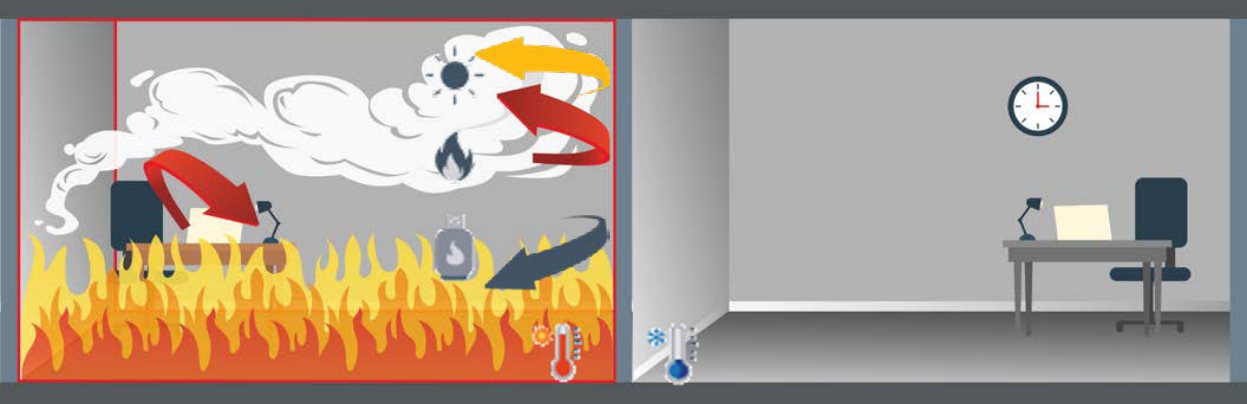
Fire resistance is intended to control the spread of fire once it has developed. Appropriate levels of fire resistance can increase the time needed for the fire to spread to higher floors and adjacent buildings. This can limit building and material loss from the fire, aid fire fighters in the evacuation of occupants and assist in the efficiency of fighting the fire.
Buildings are typically sub-divided into discrete compartments specifically intended to limit the passage of flames, smoke or heat and prevent the spread of fire to adjacent rooms. These compartments are designed to give occupants enough time to safely evacuate and increase safety margins for fire fighters. A fire compartment consists of fire-resistant walls, floors and doors. Compartment walls and floors form a complete barrier between each unit and are required to provide a minimum degree of fire resistance.
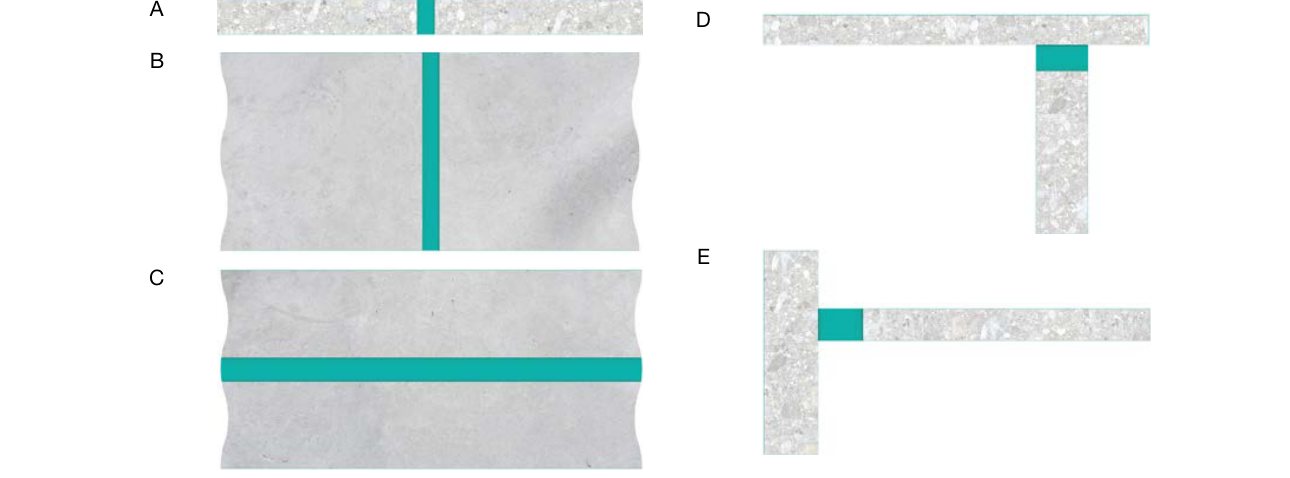
Linear joints and openings in and between fire-separating elements should be sealed with fire retardant materials to maintain the continuity of fire resistance of construction components (wall, floor, door, windows) and be able to achieve the same fire rating as adjacent building elements. The linear joints are prone to thermal movement (shrinking or expanding) during the fire and should stay fully functional. These linear joints can appear either as horizontal or vertical joints in a wall, between walls, between floors or at the connection wall to ceiling/floor.
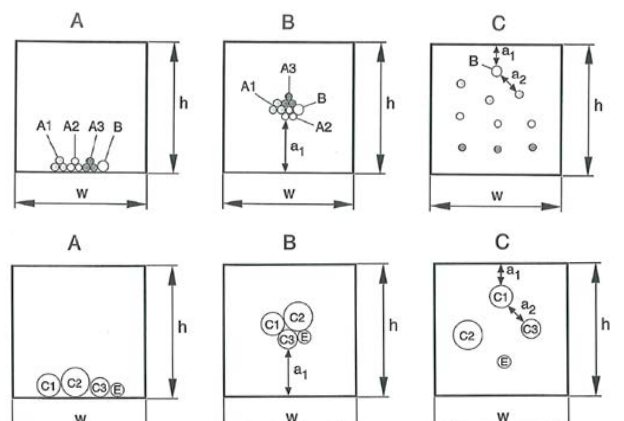
The walls and floors of a fire compartment can also have openings through which pipes and cables are fed. A fire compartment is not complete until all these openings have been sealed safely using the correct materials.
Integrity (E) and insulation (I)
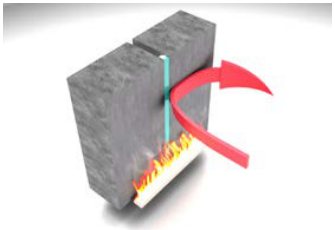
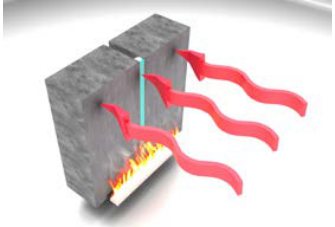
In Europe, the relevant standard for testing and classifying the fire resistance of linear joints and penetration seals are respectively the EN1366 testing standard (part 3 and part 4) and the EN13501-2 classification standard. The construction elements are tested within a gas fired furnace which simulates a fire within an enclosed room. The evaluated elements can be mounted on a wall or a floor and the temperature within the furnace rises sharply then gradually starts to level out. Thermocouples (temperature sensors) within the furnace monitor the temperature during the test to ensure the average temperature follows the correct curve. Thermocouples on the tested material follow its temperature increase. The test will assess the integrity (E) and insulation (I) capacity of the seals.
The integrity (E) defines the separation function and hence the capability of a building element, when exposed to fire on one side, to prevent the passage of flames, smoke and hot gases to the unexposed side. The integrity (E) failure is deemed to occur:
- when collapse or sustained flaming (more than 10s) on the unexposed face of the element occurs
- when openings form and allow flames or hot gases to cause flaming or glowing of a cotton fibre pad, when applied for a maximum of 30s
- when a 6mm diameter gap gauge can penetrate through a gap into the furnace and be moved in the gap for a distance of at least 150mm
- when a 25mm diameter gap gauge can penetrate through a gap into the furnace
The thermal insulating separation function (I) describes the capability of a building element to maintain its required thermal insulation separating function in case of fire. Failure is deemed to occur:
- when the mean unexposed face temperature increases by more than 140°C above its initial value
- when the temperature recorded at any position (including the roving thermocouple) on the unexposed face is in excess of 180°C above the initial mean unexposed face temperature
- when integrity failure occurs
The 180°C temperature is the limit which will lead to spontaneous ignition of materials on the fire averted side and propagate fire. The period given for the insulation failure cannot exceed that for integrity failure. If no integrity or insulation failure occurs, then the result is the time up until the agreed end of the heating period. Based on the time expressed in minutes (15, 20, 30, etc.) during which the joints manage to resist the fire and maintain integrity (E) and/or thermal insulation (I) a classification is obtained. The required classification in E and I depend on the function and location of the building element. Requirements can be less severe for instance in case of an elevator cage (which will not be used in the event of a fire) and more severe on an escape route or stairs. Requirements may differ not only based on the location of the seal in the building, but also the location of the building may impose national requirements. It is recommended that the required performance in fire resistance be verified for each project.
Test standards
Which testing is needed specifically, depends on the product’s area of application. Test standard EN1366-4 is relevant for linear joint applications. For penetration seals, the standard EN1366-3 is applicable. The BS476-20 preceded the EN1366 series and sets out the general principles for assessing the fire resistance of construction elements with part 22 addressing the testing specificities for non-load bearing construction elements. These standards provide clear criteria by which an element’s loadbearing capacity, fire containment (integrity) and the thermal transmittance (insulation) can be assessed. At the time of writing this manual, the test results obtained according to this BS476 standard series are still valid and accepted in various countries, both in and outside of Europe. It is generally accepted that materials, which have been evaluated in the past according to the BS476-20, will continue to be evaluated according to the BS476 series of standards (for instance in different configurations). Newly developed materials will typically be tested according to the EN1366 standard series. The UL equivalent for linear joints is UL2079, whilst the valid reference for penetration seals is described by UL1479. Besides UL, ASTM also provides ASTM E814 (Standard Test Method for Fire Tests of Penetration Firestop Systems) as testing standard for penetration seals which includes a high pressure hose stream test, and ASTM E1966 for linear joints.
| Product group | Description | EU standard | British standard | North America requirement |
|---|---|---|---|---|
| Firestopping | Penetration seals | EN 1366-3 | BS476-20/22 | UL 1479, ASTM E814 |
| – | Linear joints and gap seals | EN 1366-4 | BS476-20/22 | UL 2079, ASTM E1966 |
Additional specific (local/national) test results are available. Please contact your local Dow Technical Specialist for more information related to these reports.
More technical resources
For supply, quotations and technical questions on DOWSIL™ fire rated sealants, contact us. Source: Dow technical manual (Form No. 62-2233-01-0325 S2D, © 2025 The Dow Chemical Company).
sales@kconstrade.comWhatsApp