
Silicone Basics Training: Chemistry, Manufacturing, Properties and Applications
Chapter 2 “Silicone General” of the Dow Corning training material, reproduced in Korean with an English translation and supplemented with public references.
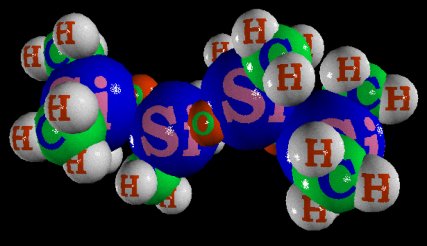
Silicone is a polymer with an inorganic Si–O backbone and organic CH₃ side groups, made from SiO₂ (sand). The Si–O bond (117 kcal/mol, 130° angle, 0.163 nm, rotation 0.2 kcal/mol) makes it heat-stable and flexible; CH₃ groups give low surface energy (PDMS 20–22 mN/m) and hydrophobicity. It is produced mainly by the Direct Process (Si + CH₃Cl → Me₂SiCl₂ 70–90%) and used as fluid, gum, resin, compound, silane, emulsion and rubber (RTV, LSR, HCR).
Contents
Frequently asked questions
When and by whom was the word “silicone” coined?
F. Kipping, who studied silicones systematically between 1899 and 1944, first named them “Silicone”.
Which process is used industrially to produce silicone?
The Direct Process, which suits mass production, rather than the Grignard Process.
What are the main products of the Direct Process with MeCl?
Dimethyldichlorosilane (Me₂SiCl₂) at 70–90%, with methyltrichlorosilane 3–15%, methyldichlorosilane 3–20%, dimethylchlorosilane 1–10%, trimethylchlorosilane 0–3% and tetramethylsilane 0.1%.
What are the steps to manufacture a silicone polymer?
Define the structure, select the catalyst, select the endblocker (acid: MM; base: MD₂M, MDM), react at a set temperature, neutralize the catalyst, filter and strip.
What is the difference between LSR and RTV silicone rubber?
LSR is usually a two-part product (vinyl-functional base with Pt catalyst; SiH crosslinker in the second part) made by stirring under heat and high shear; RTV is usually a one-part product with a hydroxy-terminated base, crosslinker, adhesion promoter and catalyst that cures at room temperature.
Why is the silicone backbone so flexible?
The Si–O bond rotates with only 0.2 kcal/mol (C–C: 3.3) and has a wide 130° bond angle and a long 0.163 nm bond, so the chain moves freely and does not tangle.
What are the main disadvantages of silicone?
Poor compatibility with other organic polymers, decomposition by strong acids and alkalis, weak corrosion protection when coated, difficult adhesion to other substances, and lower tensile and tear strength than organic rubber.
In which construction applications is silicone used?
Glazing, waterproofing, roofing sealing and building fire protection.
How is a silane primer applied?
Dilute at low concentration in a suitable solvent, apply by brush or spray, dry at room temperature, then apply the coating.
What is the surface energy of PDMS compared with other polymers?
20–22 mN/m, lower than polyethylene (31) and polystyrene (33–35) and close to PTFE (18.5); lower surface energy makes adhesion by other materials harder.
Who should I contact about DOWSIL silicone products in Korea?
Korea Construction Trading (KCT, 한국건설트레이딩): sales@kconstrade.com, 010-8939-0284.
This page is based on the following document. Values are typical, not specifications; verify with the original and product data sheets before design or purchase.
다우코닝 실리콘 교육자료 「제 2 장 실리콘 일반」(한국어, 23쪽) — Dow Corning Korea / 한국어 원문 수록 및 영어 번역: 한국건설트레이딩(KCT) / 보충: 공개 문헌 (아래 참고 자료 페이지)
Suggested citation: “Silicone Basics Training: Chemistry, Manufacturing, Properties and Applications”, Korea Construction Trading (KCT) Technical Information, https://kconstrade.com/en/technical/basics
More technical resources
For DOWSIL™ silicone selection, quotations and technical advice, please contact Korea Construction Trading. We do our best to support you technically, from product selection to process-condition review and troubleshooting. Technical support details →
sales@kconstrade.com010-8939-0284WhatsApp