Silicone polymers (fluids and gums) are made in seven steps: define structure, choose catalyst, choose endblocker, react, neutralize, filter and strip. Base catalysts (KOH, Bu₄P⁺ silanolate, Me₄NOH) or acid catalysts (H₂SO₄, triflic acid, clays, Amberlyst) drive condensation and equilibration. Silicone emulsions are made either mechanically or by emulsion polymerization, where the endblocker ratio sets the polymer molecular weight.
3. Polymer
실리콘 산업에서 가장 많이 사용되는 형태의 제품으로 여러 형태의 가공품의 원료로도 많이 사용되며, 타 제품과 반응 또는 단순 혼합의 원료로도 사용되며, 단독으로 사용되는 경우도 있다. 여기서는 흐름성이 있는 Fluid와 초고분자량의 Gum을 다 포함한다. Polymer 제조 단계는 일반적으로 다음과 같다.
- 1) 제조하고자 하는 Polymer의 구조를 정한다.
- 2) 촉매를 정한다.
- 3) Endblocker 선정, Acid: MM. Base: MD2M, MDM.
- 4) 원료를 투입하여 일정 온도 조건에서 반응시킴
- 5) 촉매의 중화 (Neutralization)
- 6) 여과 (Filtration)
- 7) 증류 (Stripping)
참고로 촉매 선택시 다음 사항을 고려하여야 한다. A. Base를 사용해야 되는 Polymer: PDMS, Trifluoro, Phenyl, Vinyl, amino polymer. B. Acid을 사용해야 되는 Polymer: PDMS, SiH, Carboxylic, Mercapto polymer. 축합 반응 및 평형 반응용 반응 촉매에는 다음과 같은 것들이 사용된다. 염기성 촉매: KOH, Bu4P+ Silanoate, Me4NOH. 산 촉매: H2SO4, Triflic Acid, Filtrol (H2SO4 Clay), Tonsil (HCl Clay), Amberlyst (H+ Resins).
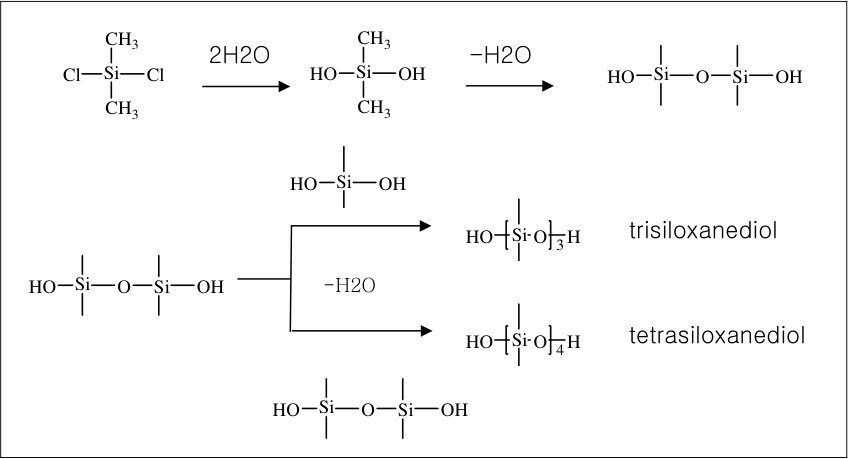
실리콘 모노머에는 선형 구조와 환형 구조의 두 가지가 있다. 그들을 중합하여 Polymer를 생성시키는 반응에는, 축합 반응 (Condensation Reaction), 평형 반응 (Equilibration Reaction)이 있다. 먼저 축합 반응에 대해 알아보자. 축합 반응에 의해 폴리머를 중합하기 위해서는 Chlorosilane의 가수분해 공정을 먼저 거쳐야 한다. Monochlorosilane은 주로 Endblocker로 사용되며, Silane 중에서는 Dichlorosilane이 가수분해되어 폴리머의 중합 원료로 사용된다. 다음은 폴리머 제조시 주원료가 되는 Dichlorosilane의 가수분해 반응을 정리한 것이다.
4. Emulsion
에멀젼이라는 것은 서로 섞이지 않는 두 상을 계면활성제를 첨가하여, Shear를 가하여 일정 크기 이하의 입자를 가지는 안정한 분산상을 말한다. 실리콘 에멀젼에는 제조 방법에 따라 두 종류가 있다.
1) 기계적인 유화 제품
Silicone Polymer를 유화제를 사용하여 물에 안정하게 분산시켜 놓는 방법이다. 유화제로는 비이온계, 양이온계, 음이온계 및 양쪽성 이온계의 유화제가 사용되며, 섬유 산업에서는 이온성 차이 때문에 많은 문제점이 있을 수 있으므로, 특별한 목적이 있거나 안정성이 우수해야 될 경우 및 이온성이 필요한 경우 외에는 비이온계 계면활성제가 사용된다. 유화 장비로는 일반 단순 Mixer, Colloid Mill, Homogenizer, Sonolater, High Shear Mixer 등이 사용된다.
2) 유화 중합 제품
원료 (D4 등의 cyclic 제품)를 먼저 유화시키고, 형성된 Micelle 내에서 중합을 시켜 고분자량의 에멀젼을 얻는 방법으로, 계면활성제는 비이온 계면활성제와 중합 촉매도 함께 하는 이온성을 띄는 계면활성제의 두 가지를 사용하는 경우가 대부분이다. 음이온 계면활성제 예, R-C6H4-SO3H. 유화 중합시, Endblocker의 비율이 에멀젼 내의 polymer의 분자량을 결정한다.
Frequently asked questions
What are the steps to manufacture a silicone polymer?
Define the structure, select the catalyst, select the endblocker (acid: MM; base: MD₂M, MDM), react at a set temperature, neutralize the catalyst, filter and strip.
What determines the molecular weight of a silicone emulsion polymer?
In emulsion polymerization the ratio of endblocker determines the polymer molecular weight.
Which surfactants are preferred in textile silicone emulsions?
Nonionic surfactants, because ionic differences can cause problems in textiles, unless a special purpose, high stability or ionicity is required.
This page is based on the following document. Values are typical, not specifications; verify with the original and product data sheets before design or purchase.
다우코닝 실리콘 교육자료 「제 2 장 실리콘 일반」(한국어, 23쪽) — Dow Corning Korea / 한국어 원문 수록 및 영어 번역: 한국건설트레이딩(KCT) / 보충: 공개 문헌 (아래 참고 자료 페이지)
Suggested citation: “Silicone Polymer and Emulsion Production”, Korea Construction Trading (KCT) Technical Information, https://kconstrade.com/en/technical/basics/polymer-and-emulsion
More technical resources
For DOWSIL™ silicone selection, quotations and technical advice, please contact Korea Construction Trading. We do our best to support you technically, from product selection to process-condition review and troubleshooting. Technical support details →
sales@kconstrade.com010-8939-0284WhatsApp