
PDMS has a surface energy of 20–22 mN/m (water 72, PTFE 18.5, polyethylene 31). A 100 cSt PDMS has Mw ≈ 6000 (DP 64); 1000 cSt ≈ 28000 (DP 320); 10000 cSt ≈ 62000 (DP 730). Silicone rubber has a water-vapour permeability of 1830 and a dimethylsilicone oxygen permeability of 60.0 (×10⁹ cm³·cm/(s·cm²·cmHg)), far above butyl rubber (0.14).
Appendix 1 — Bond-cleavage energy (kcal/mol)
| X | Si–X | C–X |
|---|---|---|
| Si | 83 | 87 |
| C | 87 | 83 |
| H | 94 | 94 |
| N | 77 | 73 |
| O | 108 | 85 |
| S | 61 | 65 |
| F | 135 | 116 |
| Cl | 106 | 81 |
| Br | 74 | 68 |
| I | 56 | 51 |
Appendix 2 — Names used in silicone chemistry
| Name | Notation | Description, example |
|---|---|---|
| Silane | 1 Si atom, –Si– | SiH₄; Dichlorosilane H₂SiCl₂; Dimethyldichlorosilane Me₂SiCl₂ |
| Disilane | 2 Si atoms, –Si–Si– | H₃Si–SiH₃ |
| Trisilane | 3 Si atoms, –Si–Si–Si– | – |
| Polysilane | Many Si atoms, (Si)ₓ | – |
| Siloxane | –Si–O–Si– (Silicone) | Hexamethyldisiloxane Me₃Si–O–SiMe₃ |
| Disiloxane | –Si–O–Si– | – |
| Trisiloxane | –Si–O–Si–O–Si– | – |
| Polysiloxane | –(Si–O)ₓ– | Polydimethylsiloxane (PDMS) Me₃SiO(Me₂SiO)ₓSiMe₃ |
| Silanol | Si–OH | Trimethylsilanol Me₃SiOH |
| Silazane | Si–N–Si | – |
| Silthiane | Si–S–Si | – |
| M | Me₃SiO | mono |
| D | Me₂SiO₂ | di |
| T | MeSiO₃ | tri |
| Q | SiO₄ | quad |
Appendix 3 — Surface energy of polymers
| Polymer | Surface energy (= surface tension), mN/m |
|---|---|
| Polydimethylsiloxane | 20–22 |
| Polystyrene | 33–35 |
| Polyacrylate | 35 |
| Polyethylene terephthalate | 43 |
| PTFE | 18.5 |
| Polyethylene | 31 |
| Wool | 45 |
| Water | 72 |
| Water + surfactant | 30 |
| Ethanol | 50 |
Appendix 4 — PDMS viscosity vs. molecular weight
| Viscosity, cSt | Molecular weight (Mw) | Degree of polymerization (n) |
|---|---|---|
| 5 | 800 | 10 |
| 20 | 2,000 | – |
| 50 | 4,000 | – |
| 100 | 6,000 | 64 |
| 200 | 9,500 | – |
| 350 | 14,000 | – |
| 500 | 17,000 | – |
| 1,000 | 28,000 | 320 |
| 5,000 | 50,000 | – |
| 10,000 | 62,000 | 730 |
| 12,500 | 68,000 | – |
| 50,000 | – | 1,300 |
| 60,000 | 117,000 | – |
| 100,000 | 140,000 | – |
| 600,000 | 260,000 | – |
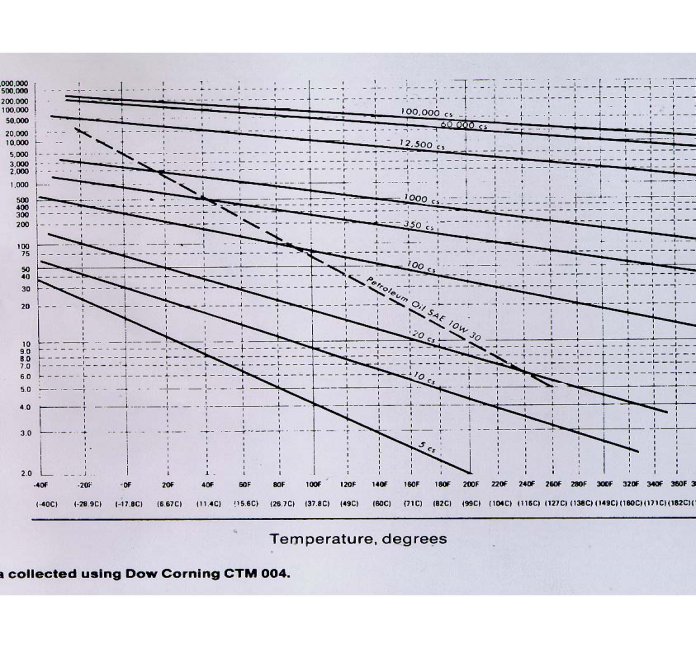
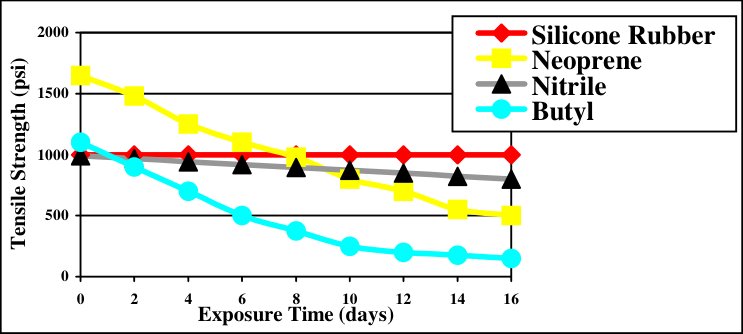
Appendices 5–8 — Thermal stability, heat ageing, permeability
| Material | P × 10⁹ |
|---|---|
| Collagen | 2710 ± 800 |
| Silicone rubber | 1830 ± 210 |
| Epoxy | 1480 ± 113 |
| Nylon 6 | 94 |
| Polystyrene | 65 ± 12 |
| Polyethylene | 11.3 ± 1.6 |
| Polymer | P × 10⁹ |
|---|---|
| Dimethylsilicone rubber | 60.0 |
| Natural rubber | 2.4 |
| Butyl rubber | 0.14 |
| Cellulose acetate | 0.08 |
| Nylon 6 | 0.004 |
| PTFE | 0.0004 |
Frequently asked questions
What is the surface energy of PDMS compared with other polymers?
20–22 mN/m, lower than polyethylene (31) and polystyrene (33–35) and close to PTFE (18.5); lower surface energy makes adhesion by other materials harder.
What do M, D, T and Q mean?
Siloxane unit notations: M = Me₃SiO (mono), D = Me₂SiO₂ (di), T = MeSiO₃ (tri), Q = SiO₄ (quad).
This page is based on the following document. Values are typical, not specifications; verify with the original and product data sheets before design or purchase.
다우코닝 실리콘 교육자료 「제 2 장 실리콘 일반」(한국어, 23쪽) — Dow Corning Korea / 한국어 원문 수록 및 영어 번역: 한국건설트레이딩(KCT) / 보충: 공개 문헌 (아래 참고 자료 페이지)
Suggested citation: “Appendix: Bond Energies, Nomenclature, Surface Energy, Viscosity–Molecular Weight, Heat and Permeability Data”, Korea Construction Trading (KCT) Technical Information, https://kconstrade.com/en/technical/basics/appendix-data
More technical resources
For DOWSIL™ silicone selection, quotations and technical advice, please contact Korea Construction Trading. We do our best to support you technically, from product selection to process-condition review and troubleshooting. Technical support details →
sales@kconstrade.com010-8939-0284WhatsApp