
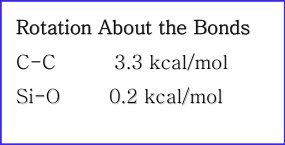
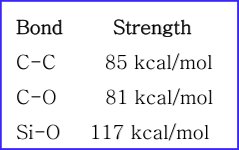
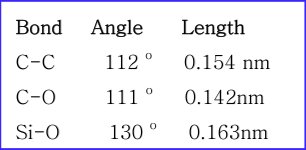
Si–O bond: bond energy 117 kcal/mol (C–C 85, C–O 81), rotation barrier 0.2 kcal/mol (C–C 3.3), bond angle 130° (C–C 112°), bond length 0.163 nm (C–C 0.154). The strong, long, freely rotating backbone gives heat stability and flexibility; the CH₃ side groups give low surface energy and hydrophobicity. PDMS Tg is −121 °C.
II. 1. Silicone molecular characteristics
실리콘 분자의 특성은 일반 유기 화학 제품의 분자 특성과 다른 점이 많이 있다. 그러한 특유의 실리콘 분자의 특성은 결과적으로 실리콘 재료의 여러 가지 장점과 단점에 직접적으로 관련이 있다.
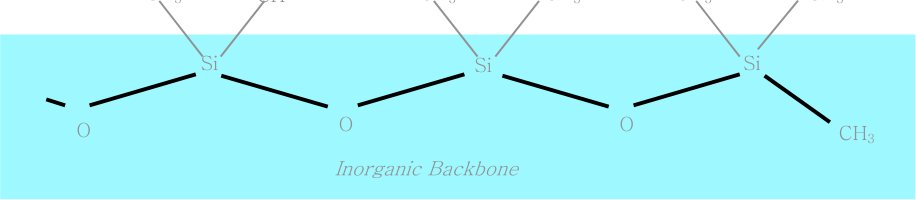
실리콘 분자의 가장 특징적인 것은, Si-O의 무기 주쇄와 CH3의 유기 측쇄, 즉 유기와 무기 결합이 동시에 존재한다는 것이다. 따라서 Silicone이라는 물질은 Si-O로부터 얻어지는 무기물의 특성과 CH3 등의 유기 부분으로부터 얻어지는 유기물의 특성을 동시에 가지고 있어 그 특성이 특이하다.
- Si-O 무기 주쇄: 높은 표면 에너지를 가짐. 기질과의 접촉면과 상호 작용을 함.
- CH3 유기 측쇄: 낮은 표면 에너지를 가짐. 실리콘의 표면 특성을 나타냄. 소수성. 상호간의 낮은 분자력으로 인한 낮은 표면 에너지를 가지며, 그것은 분자의 표면장력을 낮게 함.
Summary of molecular characteristics
일반적으로 실리콘 분자의 특성은 다음과 같이 정리할 수 있다.
- 결합이 길고 강하고 안정함.
- 분자의 움직임이 자유로움.
- 사슬이 서로 엉키지 않음.
- 끈적거리지 않음.
- -CH3 기의 불활성 때문에 낮은 분자간 인력을 가짐. CH3기 간의 낮은 분자간 인력은 낮은 표면 에너지에 영향을 미치고 이는 또 낮은 표면 장력과 관련이 있다. Silicone의 유동적인 주쇄는 CH3기의 효과를 증대시킨다. 고분자량의 폴리머라도 유기 폴리머에 비해 흐름성이 탁월하다.
| Property | Silicone | Aliphatic hydrocarbon |
|---|---|---|
| Electronegativity | Si – 1.8 | C – 2.5 |
| Rotation energy, kcal/mol | Si–O: 0.2 | C–C: 3.3 |
| Bond energy, kcal/mol | Si–O: 117 | C–C: 85, C–O: 81 |
| Bond length, nm | Si–O: 0.163 | C–C: 0.154, C–O: 0.142 |
| Bond angle | Si–O: 130° | C–C: 112°, C–O: 111° |
| Tg | PDMS: −121 °C |
Frequently asked questions
Why is the silicone backbone so flexible?
The Si–O bond rotates with only 0.2 kcal/mol (C–C: 3.3) and has a wide 130° bond angle and a long 0.163 nm bond, so the chain moves freely and does not tangle.
Why does silicone resist heat better than organic polymers?
The Si–O bond energy is 117 kcal/mol versus 85 for C–C and 81 for C–O.
This page is based on the following document. Values are typical, not specifications; verify with the original and product data sheets before design or purchase.
다우코닝 실리콘 교육자료 「제 2 장 실리콘 일반」(한국어, 23쪽) — Dow Corning Korea / 한국어 원문 수록 및 영어 번역: 한국건설트레이딩(KCT) / 보충: 공개 문헌 (아래 참고 자료 페이지)
Suggested citation: “Characteristics of the Silicone Molecule: Si–O Backbone and CH₃ Side Groups”, Korea Construction Trading (KCT) Technical Information, https://kconstrade.com/en/technical/basics/molecular-characteristics
More technical resources
For DOWSIL™ silicone selection, quotations and technical advice, please contact Korea Construction Trading. We do our best to support you technically, from product selection to process-condition review and troubleshooting. Technical support details →
sales@kconstrade.com010-8939-0284WhatsApp