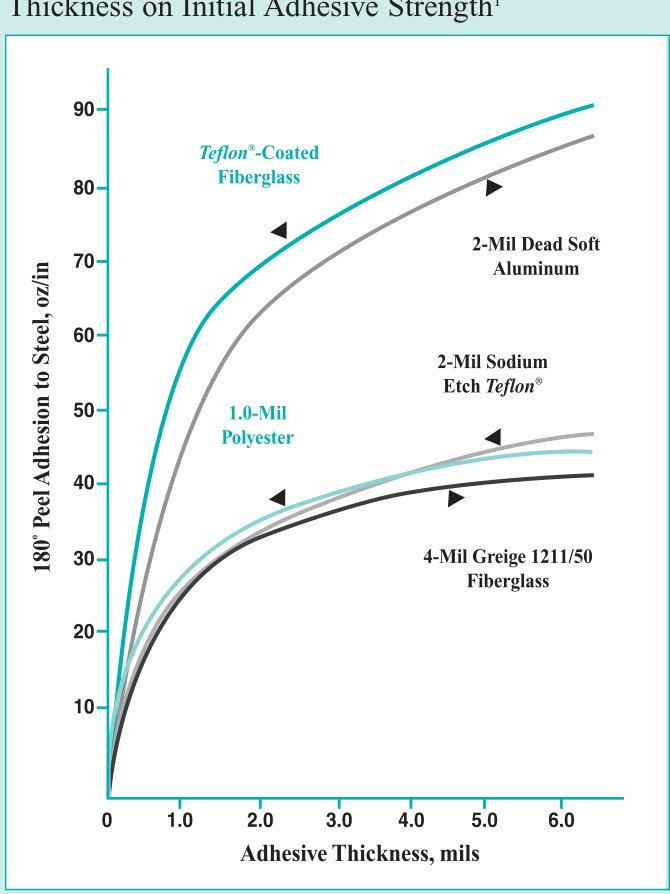
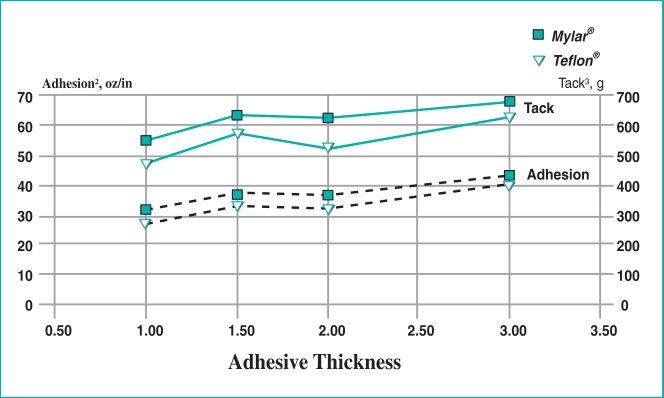
Silicone PSAs can be applied as supplied on conventional tape-coating equipment but are usually diluted with toluene, xylene or other nonpolar solvents; coat-weight control is critical. The thicker the cured adhesive coating, the higher the adhesion and tack, and the backing material also affects both.
Processing and Curing Considerations
Silicone PSAs from Dow Corning can be applied to backing materials as supplied using conventional tape coating equipment. However, they are most often diluted with toluene, xylene or other nonpolar solvents to achieve a coatable viscosity. Coat weight control is critical for consistent performance. In addition, peroxide-cure silicone PSAs from Dow Corning may be blended with other dimethyl-type silicone PSAs to modify the performance of the cured coating.
Effects of substrate variation and adhesive thickness
The backing material to which a silicone PSA is applied affects its tack and adhesion values. Adhesive thickness also affects adhesive performance: the thicker the cured adhesive coating, the higher the adhesion and tack. See Figures 1, 2, 4 and 5.
Frequently asked questions
How are silicone PSAs usually coated?
On conventional tape coating equipment, typically diluted with toluene, xylene or another nonpolar solvent to reach a coatable viscosity.
Does a thicker PSA layer raise adhesion?
Yes — the thicker the cured coating, the higher the adhesion and tack.
This page is based on the following document. Values are typical, not specifications; verify with the original and product data sheets before design or purchase.
Dow, “Silicone PSAs for High Performance Selection Guide”, Form No. 30-1315-01-0524 S2D, © 2024 The Dow Chemical Company (2024 최신판); Dow Corning, “Product Selection and Application Guide — Dow Corning® brand High-Performance Silicone PSAs”, Form No. 30-083B-01 (AGP7825), ©2001, 2006 Dow Corning Corporation (2006 구판). 한국어 번역·정리: 한국건설트레이딩(KCT)
Suggested citation: “Processing Considerations: Substrate and Adhesive Thickness Effects (Figures 4–5)”, Korea Construction Trading (KCT) Technical Information, https://kconstrade.com/en/technical/psa/processing-thickness-effects
More technical resources
For DOWSIL™ silicone selection, quotations and technical advice, please contact Korea Construction Trading. We do our best to support you technically, from product selection to process-condition review and troubleshooting. Technical support details →
sales@kconstrade.com010-8939-0284WhatsApp