Si 금속(순도 98%)은 2600°C에서 SiO₂ + 2C → Si + 2CO로 만듭니다. MeCl을 이용한 Direct Process에서 주생성물은 Me₂SiCl₂(디메틸디클로로실란) 70~90%이며, 실리콘 레진은 삼차원 망상 구조로 트리클로로실란(RSiCl₃)의 가수분해로 얻는 (RSiO₃/₂)n(실세스퀴옥산)입니다.
2.3 제품별 제조 방법
Classification by product form was described earlier. By functional group, the products are almost the same as in organic chemistry: alkyl, aryl, allyl, alkenyl, amido, amino, fluoroalkyl, halide, epoxy, carboxy, hydroxy, alkoxy, methyl hydrogen, etc. Si-containing copolymers include siloxane-urethane, siloxane-polycarbonate, siloxane-polyester and siloxane-polyimide copolymers, acryloxymethylsiloxane, p-styrylsiloxane and polysilformal (a copolymer of silicone and aldehyde). Manufacturing methods for each silicone product follow.
English translation
실리콘 제품의 형태에 따른 분류는 이전에 기술하였다. 그리고 관능기에 따라 분류하면 다음과 같은 제품들이 있다. 이는 유기화학의 관능기와 거의 유사하다 - Alkyl기, Aryl기, Allyl기, Alkenyl, Amido, Amino, Fluoroalkyl, Halide, Epoxy, Carboxy, Hydroxy, Alkoxy, Methyl Hydrogen 등. 그리고 Si를 포함하는 Copolymer에는 다음과 같은 것들이 있다. Siloxane-urethane copolymer, Siloxane-polycarbonate copolymer, Siloxane-polyester copolymer, Siloxane-polyimide copolymer, Acryloxymethylsiloxane, p-Styrylsiloxane, Polysilformal (Silicone과 Aldehyde와의 Copolymer) 등. 여기서는 각 실리콘 제품의 제조 방법에 대해서 알아보겠다.
1. 실란 (Silane)
Before silanes can be made, the most basic step of silicone synthesis is making Si metal: SiO₂ + 2C → Si + 2CO at 2600°C. The silicon obtained is a smelted metal of 98% purity. Silanes are made from this Si metal by the Direct Process, of which there are two routes:
English translation
실란의 제조 이전에, 실리콘 합성의 가장 기본이 되는 Si (Silicon) 금속의 제조 과정은 다음과 같다. SiO2 + 2C → Si + 2CO (2600°C). 여기서 Silicon은 98% 순수한 제련된 금속이다. 위에서 제조된 Si 금속을 이용하여 Silane을 만드는데, Silane의 일반적인 제조 방법인 Direct Process에 대한 설명이다. 두 가지 방법이 있다.
- 1) Si(s) + HCl(g) → HSiCl₃ + SiCl₄ + H₂ + DPR
- 2) Si(s) + MeCl(g) → MexSiCl(4−x) + by-products
English translation
- 1) Si(s) + HCl(g) → HSiCl3 + SiCl4 + H2 + DPR
- 2) Si(s) + MeCl(g) → MexSiCl(4-x) + by-products
The HSiCl₃ and SiCl₄ made by route #1 are used as raw materials for resin, silica and other special products. The table below lists the silanes formed by route #2, their content and boiling points.
English translation
#1)의 방법으로 제조된 HSiCl3나 SiCl4는 각각 Resin이나 Silica 또는 그 외 특수한 제품을 만드는 데 원료로 사용된다. 다음은 Direct Process 중 상기 #2) 반응에 의해 Silane 제조시 생성된 Silane의 종류와 함량 그리고 B.P에 대해 정리한 내용이다.
| 주 생성물 | 명명 | 함량 (%) | B.P., °C / 760mm |
|---|---|---|---|
| Me₂SiCl₂ | dimethyldichlorosilane | 70–90 | 70.2 |
| MeSiCl₃ | methyltrichlorosilane | 3–15 | 66.1 |
| Me₃SiCl | trimethylchlorosilane | 0–3 | 57.3 |
| MeHSiCl₂ | methyldichlorosilane | 3–20 | 40.4 |
| Me₂HSiCl | dimethylchlorosilane | 1–10 | 35.4 |
| Me₄Si | tetramethylsilane | 0.1 | 26.2 |
2. 레진 (Resin)
Resin has a three-dimensional network structure, so it is made by hydrolysis of trichlorosilane, which has three reactive groups: RSiCl₃ + H₂O → [RSi(OH)₃] + HCl → (RSiO₃/₂)ₙ, silicone resin (= silsesquioxane). Examples: phenyl resin, H-resin.
English translation
Resin은 삼차원적 망상 구조를 가지므로, 반응기가 세 개인 Trichlorosilane의 가수분해로부터 제조된다. RSiCl3 + H2O → [RSi(OH)3] + HCl → (RSiO3/2)n Silicone Resin (= Silsesquioxane). 예, Phenyl Resin, H-Resin.
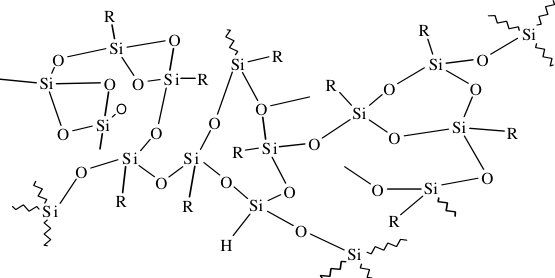
English caption
실리콘 레진의 분자 구조 (Silicone Resin의 Molecular Structure)
자주 묻는 질문
MeCl을 이용한 Direct Process의 주생성물은 무엇입니까?
디메틸디클로로실란(Me₂SiCl₂) 70~90%이며, 메틸트리클로로실란 3~15%, 메틸디클로로실란 3~20%, 디메틸클로로실란 1~10%, 트리메틸클로로실란 0~3%, 테트라메틸실란 0.1%가 함께 생성됩니다.
실리콘 레진은 어떻게 만듭니까?
반응기가 세 개인 트리클로로실란(RSiCl₃)을 가수분해하여 삼차원 망상 구조의 (RSiO₃/₂)n, 즉 실세스퀴옥산을 얻습니다.
이 페이지는 다음 문서를 바탕으로 정리했습니다. 수치는 대표 값이며 시방 값이 아니므로 설계·구매 전에 원문과 제품 데이터 시트를 확인하십시오.
다우코닝 실리콘 교육자료 「제 2 장 실리콘 일반」(한국어, 23쪽) — Dow Corning Korea / 한국어 원문 수록 및 영어 번역: 한국건설트레이딩(KCT) / 보충: 공개 문헌 (아래 참고 자료 페이지)
인용 예시: “제품별 제조 방법 – 실란(Silane)과 레진(Resin)”, 한국건설트레이딩(KCT) 기술정보, https://kconstrade.com/ko/technical/basics/silane-and-resin
다른 기술정보 자료
DOWSIL™ 실리콘 제품 선정, 견적, 기술 상담은 한국건설트레이딩으로 문의해 주십시오. 한국건설트레이딩은 제품 선정부터 공정 조건 검토와 문제 해결까지 기술 지원을 위해 최선을 다하겠습니다. 기술 지원 안내 →
sales@kconstrade.com010-8939-0284WhatsApp