
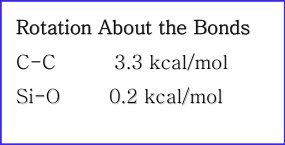
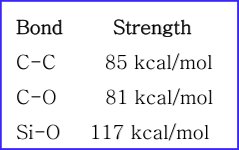
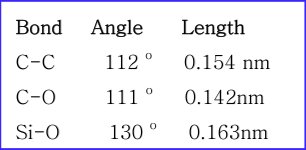
Si-O 결합은 결합 에너지 117 kcal/mol(C-C 85, C-O 81), 회전 에너지 0.2 kcal/mol(C-C 3.3), 결합각 130°(C-C 112°), 결합 길이 0.163 nm(C-C 0.154)입니다. 강하고 길며 자유롭게 회전하는 주쇄가 열안정성과 유연성을, CH₃ 측쇄가 낮은 표면 에너지와 소수성을 줍니다. PDMS의 Tg는 −121 °C입니다.
II. 1. 실리콘 분자의 특성
The molecular characteristics of silicone differ in many ways from those of ordinary organic chemicals. These characteristics are directly related to the many advantages and disadvantages of silicone materials.
English translation
실리콘 분자의 특성은 일반 유기 화학 제품의 분자 특성과 다른 점이 많이 있다. 그러한 특유의 실리콘 분자의 특성은 결과적으로 실리콘 재료의 여러 가지 장점과 단점에 직접적으로 관련이 있다.
English caption
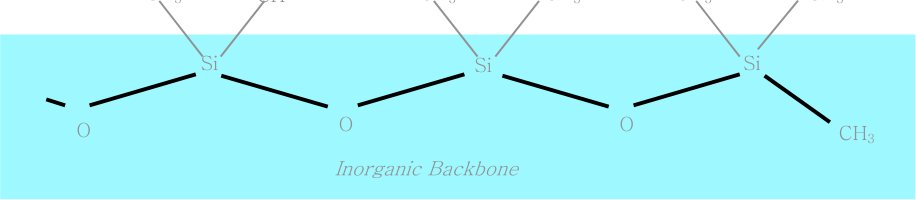
실리콘 분자의 구조 및 주쇄의 특성 — 유기기(CH3)와 무기 주쇄(Si-O)
English caption
The Si–O bond rotates freely: rotation about the bond C–C 3.3 kcal/mol, Si–O 0.2 kcal/mol
English caption
The Si–O bond is stable: bond strength C–C 85, C–O 81, Si–O 117 kcal/mol
English caption
Bond angle and length: C–C 112° / 0.154 nm, C–O 111° / 0.142 nm, Si–O 130° / 0.163 nm
The most distinctive feature of the silicone molecule is that an inorganic Si–O backbone and organic CH₃ side chains exist together. Silicone therefore has both the properties of the inorganic material obtained from Si–O and those of the organic part such as CH₃, which makes its behaviour unusual.
English translation
실리콘 분자의 가장 특징적인 것은, Si-O의 무기 주쇄와 CH3의 유기 측쇄, 즉 유기와 무기 결합이 동시에 존재한다는 것이다. 따라서 Silicone이라는 물질은 Si-O로부터 얻어지는 무기물의 특성과 CH3 등의 유기 부분으로부터 얻어지는 유기물의 특성을 동시에 가지고 있어 그 특성이 특이하다.
- Si–O inorganic backbone: high surface energy; interacts with the substrate at the contact surface.
- CH₃ organic side chains: low surface energy; they determine the surface properties of silicone. Hydrophobic. Low intermolecular force gives low surface energy, which lowers the surface tension of the molecule.
English translation
- Si-O 무기 주쇄: 높은 표면 에너지를 가짐. 기질과의 접촉면과 상호 작용을 함.
- CH3 유기 측쇄: 낮은 표면 에너지를 가짐. 실리콘의 표면 특성을 나타냄. 소수성. 상호간의 낮은 분자력으로 인한 낮은 표면 에너지를 가지며, 그것은 분자의 표면장력을 낮게 함.
분자 특성 요약 및 유기 화합물과의 비교
In general the characteristics of the silicone molecule can be summarized as follows.
English translation
일반적으로 실리콘 분자의 특성은 다음과 같이 정리할 수 있다.
- Bonds are long, strong and stable.
- Molecular motion is free.
- Chains do not tangle with each other.
- Not sticky.
- Low intermolecular attraction because the –CH₃ groups are inert. The low attraction between CH₃ groups lowers surface energy, which relates to low surface tension. The flexible backbone amplifies the effect of the CH₃ groups. Even high-molecular-weight polymers flow far better than organic polymers.
English translation
- 결합이 길고 강하고 안정함.
- 분자의 움직임이 자유로움.
- 사슬이 서로 엉키지 않음.
- 끈적거리지 않음.
- -CH3 기의 불활성 때문에 낮은 분자간 인력을 가짐. CH3기 간의 낮은 분자간 인력은 낮은 표면 에너지에 영향을 미치고 이는 또 낮은 표면 장력과 관련이 있다. Silicone의 유동적인 주쇄는 CH3기의 효과를 증대시킨다. 고분자량의 폴리머라도 유기 폴리머에 비해 흐름성이 탁월하다.
| 항목 | 실리콘계 | 지방족 탄화 수소계 |
|---|---|---|
| 전기 음성도 | Si – 1.8 | C – 2.5 |
| 회전 에너지, kcal/mole | Si–O: 0.2 | C–C: 3.3 |
| 결합 에너지, kcal/mole | Si–O: 117 | C–C: 85, C–O: 81 |
| 결합 길이, nm | Si–O: 0.163 | C–C: 0.154, C–O: 0.142 |
| 결합각 | Si–O: 130° | C–C: 112°, C–O: 111° |
| Tg | PDMS: −121 °C |
자주 묻는 질문
실리콘 주쇄는 왜 유연합니까?
Si-O 결합은 회전 에너지가 0.2 kcal/mol(C-C 3.3)로 낮고 결합각 130°, 결합 길이 0.163 nm로 넓고 길어 사슬이 자유롭게 움직이며 서로 엉키지 않습니다.
실리콘이 유기 고분자보다 열에 강한 이유는?
Si-O 결합 에너지가 117 kcal/mol로 C-C(85), C-O(81)보다 크기 때문입니다.
이 페이지는 다음 문서를 바탕으로 정리했습니다. 수치는 대표 값이며 시방 값이 아니므로 설계·구매 전에 원문과 제품 데이터 시트를 확인하십시오.
다우코닝 실리콘 교육자료 「제 2 장 실리콘 일반」(한국어, 23쪽) — Dow Corning Korea / 한국어 원문 수록 및 영어 번역: 한국건설트레이딩(KCT) / 보충: 공개 문헌 (아래 참고 자료 페이지)
인용 예시: “실리콘 분자의 특성 – Si-O 주쇄와 CH₃ 측쇄”, 한국건설트레이딩(KCT) 기술정보, https://kconstrade.com/ko/technical/basics/molecular-characteristics
다른 기술정보 자료
DOWSIL™ 실리콘 제품 선정, 견적, 기술 상담은 한국건설트레이딩으로 문의해 주십시오. 한국건설트레이딩은 제품 선정부터 공정 조건 검토와 문제 해결까지 기술 지원을 위해 최선을 다하겠습니다. 기술 지원 안내 →
sales@kconstrade.com010-8939-0284WhatsApp