실리콘 폴리머(Fluid·Gum)는 구조 결정 → 촉매 → Endblocker 선정 → 반응 → 중화 → 여과 → 증류(Stripping)의 7단계로 제조하며, 염기(KOH, Bu₄P⁺ Silanoate, Me₄NOH) 또는 산(H₂SO₄, Triflic Acid, Filtrol, Tonsil, Amberlyst) 촉매로 축합·평형 반응을 진행합니다. 실리콘 에멀젼은 기계적 유화 또는 유화 중합으로 만들며, 유화 중합에서는 Endblocker 비율이 분자량을 결정합니다.
3. 폴리머 (Polymer)
Polymer is the most widely used silicone product form. It is a raw material for many processed products, is reacted or simply mixed with other products, and is sometimes used alone. It covers both flowable fluids and ultra-high-molecular-weight gums. Polymer manufacture generally follows these steps:
English translation
실리콘 산업에서 가장 많이 사용되는 형태의 제품으로 여러 형태의 가공품의 원료로도 많이 사용되며, 타 제품과 반응 또는 단순 혼합의 원료로도 사용되며, 단독으로 사용되는 경우도 있다. 여기서는 흐름성이 있는 Fluid와 초고분자량의 Gum을 다 포함한다. Polymer 제조 단계는 일반적으로 다음과 같다.
- 1) Decide the structure of the polymer to be made.
- 2) Select the catalyst.
- 3) Select the endblocker — acid: MM; base: MD₂M, MDM.
- 4) Charge the raw materials and react at a set temperature.
- 5) Neutralize the catalyst.
- 6) Filtration.
- 7) Stripping (distillation).
English translation
- 1) 제조하고자 하는 Polymer의 구조를 정한다.
- 2) 촉매를 정한다.
- 3) Endblocker 선정, Acid: MM. Base: MD2M, MDM.
- 4) 원료를 투입하여 일정 온도 조건에서 반응시킴
- 5) 촉매의 중화 (Neutralization)
- 6) 여과 (Filtration)
- 7) 증류 (Stripping)
For catalyst selection: (A) polymers that need a base: PDMS, trifluoro, phenyl, vinyl and amino polymers; (B) polymers that need an acid: PDMS, SiH, carboxylic and mercapto polymers. Catalysts used for condensation and equilibration reactions — basic: KOH, Bu₄P⁺ silanolate, Me₄NOH; acidic: H₂SO₄, triflic acid, Filtrol (H₂SO₄ clay), Tonsil (HCl clay), Amberlyst (H⁺ resins).
English translation
참고로 촉매 선택시 다음 사항을 고려하여야 한다. A. Base를 사용해야 되는 Polymer: PDMS, Trifluoro, Phenyl, Vinyl, amino polymer. B. Acid을 사용해야 되는 Polymer: PDMS, SiH, Carboxylic, Mercapto polymer. 축합 반응 및 평형 반응용 반응 촉매에는 다음과 같은 것들이 사용된다. 염기성 촉매: KOH, Bu4P+ Silanoate, Me4NOH. 산 촉매: H2SO4, Triflic Acid, Filtrol (H2SO4 Clay), Tonsil (HCl Clay), Amberlyst (H+ Resins).
Silicone monomers are either linear or cyclic. The reactions that polymerize them are the condensation reaction and the equilibration reaction. For condensation polymerization, chlorosilane must first be hydrolyzed. Monochlorosilane is mainly used as an endblocker, while among the silanes dichlorosilane is hydrolyzed and used as the polymerization raw material. Hydrolysis of dichlorosilane, the main raw material, is summarized below.
English translation
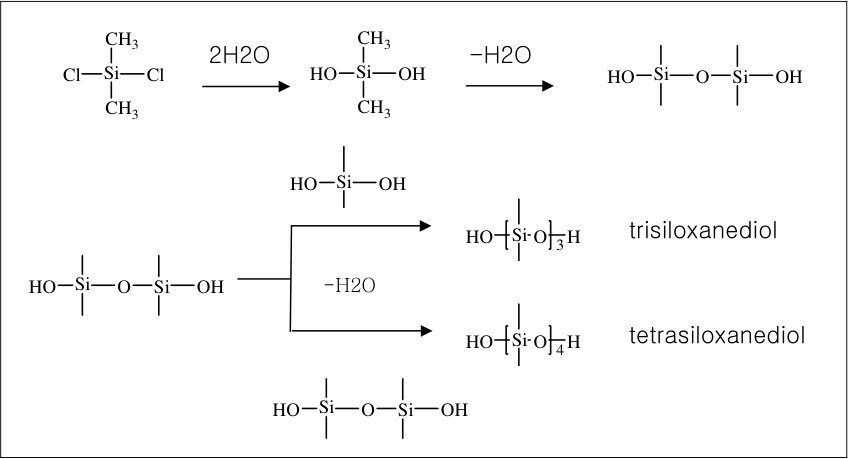
실리콘 모노머에는 선형 구조와 환형 구조의 두 가지가 있다. 그들을 중합하여 Polymer를 생성시키는 반응에는, 축합 반응 (Condensation Reaction), 평형 반응 (Equilibration Reaction)이 있다. 먼저 축합 반응에 대해 알아보자. 축합 반응에 의해 폴리머를 중합하기 위해서는 Chlorosilane의 가수분해 공정을 먼저 거쳐야 한다. Monochlorosilane은 주로 Endblocker로 사용되며, Silane 중에서는 Dichlorosilane이 가수분해되어 폴리머의 중합 원료로 사용된다. 다음은 폴리머 제조시 주원료가 되는 Dichlorosilane의 가수분해 반응을 정리한 것이다.
English caption
Dichlorosilane의 가수분해 (2H2O, -H2O → trisiloxanediol, tetrasiloxanediol). 생성된 Monomer들은 축합 반응을 통해 n HO-(Me2SiO)m-H → HO-(Me2SiO)nm-H 의 Polymer가 된다.
4. 에멀젼 (Emulsion)
An emulsion is a stable dispersion with particles below a certain size, obtained by adding a surfactant to two immiscible phases and applying shear. Silicone emulsions are of two kinds, depending on the manufacturing method.
English translation
에멀젼이라는 것은 서로 섞이지 않는 두 상을 계면활성제를 첨가하여, Shear를 가하여 일정 크기 이하의 입자를 가지는 안정한 분산상을 말한다. 실리콘 에멀젼에는 제조 방법에 따라 두 종류가 있다.
1) Mechanical emulsification
Silicone polymer is dispersed stably in water using an emulsifier. Nonionic, cationic, anionic and amphoteric emulsifiers are used; in the textile industry differences in ionicity can cause many problems, so nonionic surfactants are used unless there is a special purpose, excellent stability is needed or ionicity is required. Equipment includes simple mixers, colloid mills, homogenizers, sonolators and high-shear mixers.
English translation
Silicone Polymer를 유화제를 사용하여 물에 안정하게 분산시켜 놓는 방법이다. 유화제로는 비이온계, 양이온계, 음이온계 및 양쪽성 이온계의 유화제가 사용되며, 섬유 산업에서는 이온성 차이 때문에 많은 문제점이 있을 수 있으므로, 특별한 목적이 있거나 안정성이 우수해야 될 경우 및 이온성이 필요한 경우 외에는 비이온계 계면활성제가 사용된다. 유화 장비로는 일반 단순 Mixer, Colloid Mill, Homogenizer, Sonolater, High Shear Mixer 등이 사용된다.
2) Emulsion polymerization
The raw material (cyclics such as D4) is emulsified first and polymerized inside the micelles formed, giving a high-molecular-weight emulsion. Most often two surfactants are used: a nonionic one and an ionic one that also acts as the polymerization catalyst (anionic example: R–C₆H₄–SO₃H). In emulsion polymerization, the ratio of endblocker determines the molecular weight of the polymer in the emulsion.
English translation
원료 (D4 등의 cyclic 제품)를 먼저 유화시키고, 형성된 Micelle 내에서 중합을 시켜 고분자량의 에멀젼을 얻는 방법으로, 계면활성제는 비이온 계면활성제와 중합 촉매도 함께 하는 이온성을 띄는 계면활성제의 두 가지를 사용하는 경우가 대부분이다. 음이온 계면활성제 예, R-C6H4-SO3H. 유화 중합시, Endblocker의 비율이 에멀젼 내의 polymer의 분자량을 결정한다.
자주 묻는 질문
실리콘 폴리머 제조 단계는 어떻게 됩니까?
구조 결정 → 촉매 선정 → Endblocker 선정(산: MM, 염기: MD2M·MDM) → 일정 온도에서 반응 → 촉매 중화 → 여과 → 증류(Stripping) 순입니다.
실리콘 에멀젼 폴리머의 분자량은 무엇이 결정합니까?
유화 중합에서는 Endblocker의 비율이 에멀젼 내 폴리머의 분자량을 결정합니다.
섬유용 실리콘 에멀젼에는 어떤 계면활성제를 씁니까?
이온성 차이로 문제가 생길 수 있어, 특별한 목적·우수한 안정성·이온성이 필요한 경우를 제외하고는 비이온계 계면활성제를 사용합니다.
이 페이지는 다음 문서를 바탕으로 정리했습니다. 수치는 대표 값이며 시방 값이 아니므로 설계·구매 전에 원문과 제품 데이터 시트를 확인하십시오.
다우코닝 실리콘 교육자료 「제 2 장 실리콘 일반」(한국어, 23쪽) — Dow Corning Korea / 한국어 원문 수록 및 영어 번역: 한국건설트레이딩(KCT) / 보충: 공개 문헌 (아래 참고 자료 페이지)
인용 예시: “폴리머(Polymer)와 에멀젼(Emulsion)의 제조”, 한국건설트레이딩(KCT) 기술정보, https://kconstrade.com/ko/technical/basics/polymer-and-emulsion
다른 기술정보 자료
DOWSIL™ 실리콘 제품 선정, 견적, 기술 상담은 한국건설트레이딩으로 문의해 주십시오. 한국건설트레이딩은 제품 선정부터 공정 조건 검토와 문제 해결까지 기술 지원을 위해 최선을 다하겠습니다. 기술 지원 안내 →
sales@kconstrade.com010-8939-0284WhatsApp