Platinum-cure DOWSIL™ PSAs need SYL-OFF™ 4000 Catalyst and the coating bath should be used within six hours (the 2006 guide said 24 hours); they cure from 80 °C (typical dwell: 2 min at 100 °C to 1 min at 125 °C). Peroxide-cure PSAs use 0.5–3.0% benzoyl peroxide by weight; remove solvent at 65–93 °C first, then typically 1 min at 66 °C followed by 2 min at 177–204 °C.
Processing and curing considerations
Dow silicone PSAs can be applied to backing materials as supplied, using conventional tape-coating equipment. However, they are most often diluted with toluene, xylene or other nonpolar solvents to achieve a coatable viscosity*. Coat-weight control is critical for consistent performance. In addition, Dow silicone PSAs may be blended to modify the performance of the cured coating. Contact your Dow representative for information on blending PSAs.
Effects of substrate variation and adhesive thickness
The backing material to which a silicone PSA is applied affects its tack and adhesion values. Adhesive thickness also affects adhesive performance: The thicker the cured adhesive coating, the higher the adhesion and tack.
Platinum cure
Platinum-cure adhesives from Dow require the addition of a platinum catalyst (SYL-OFF™ 4000 Catalyst) to develop PSA properties. The coating bath should be used within six hours of catalyst addition. These adhesives can be cured in vented, continuous coating ovens at temperatures as low as 80°C (176°F). When coated onto flexible substrates such as polyester or polyolefin films, typical oven dwell times range from 2 minutes at 100°C (212°F) to 1 minute at 125°C (257°F). If the cure rate needs to be increased to accommodate a shorter oven dwell time (to increase line speed, for example) or the process oven temperatures lowered, the catalyst level can be increased. Changing the catalyst level has little impact on the tack, adhesion or cohesive strength of the cured adhesive. Note: Because the catalyst is subject to contamination by peroxide and other materials, mixing and coating equipment must be thoroughly cleaned, and dedicated new containers should be used for mixing.
Peroxide cure
To achieve a good balance of tack, adhesive strength and cohesive strength over a wide range of operating temperatures, proper cure is essential. The catalyst typically used with silicone PSAs is benzoyl peroxide. Peroxide concentration can be varied from 0.5 to 3.0 percent by weight (based on adhesive solids). Increasing peroxide concentration will decrease the tack and adhesive strength of the cured coating but increase its cohesive strength. The most consistent results are achieved by using powdered 98 percent benzoyl peroxide. Complete blending of peroxide and adhesive is best obtained by making a 10 percent w/v solution of the peroxide in toluene. If a catalyst is added, the coating bath should be used within a day after mixing, as the peroxide loses its activity quite rapidly in solvent. Thorough dispersion of the adhesive and peroxide during mixing is necessary to achieve uniform results in the finished product. Curing the adhesive is a two-step process that requires the use of graded temperatures.
Solvent removal
The first step in curing the adhesive, following its application to the backing material, is solvent removal. Recommended temperatures for solvent removal range from 65°C to 93°C (150 to 200°F). Higher removal temperatures can cause the peroxide to decompose prematurely and crosslink the solvent into the adhesive, potentially reducing the properties of the finished tape. The length of time for solvent removal should be sufficient to ensure that no solvent is present in the adhesive when it enters the curing zone.
Heat cure
After the solvent is removed, a tacky, uniform film of adhesive is left on the backing. This film’s adhesive and cohesive strengths, as well as the tack, can be further developed by a heat cure. The amount of cure depends on a number of factors, including the type of catalyst or equipment and backing material. A cure of 1 minute at 66°C (150°F) for solvent removal, followed by 2 minutes at 177 to 204°C (350 to 400°F) is typically used for adhesives that contain benzoyl peroxide. If equipment and type of backing material permit the use of higher curing temperatures, the cure time may be shortened. Higher cure temperatures develop the cohesive strength of the adhesive in less time than at lower temperatures. The ultimate adhesive strength of the fully cured material is essentially the same whether cured at higher or lower temperatures; the only difference is the time required to reach complete cure.
Oven dusting and anchorage
Oven dusting: the evaporation of volatile silicone in the curing oven can cause the formation of oven dust. The problem is typical in solvent incineration or air-recirculating direct-fired ovens and is especially prevalent in ovens that deliver too much heat too early in the cure process. Two ways to reduce the problem are to: (1) select silicone PSAs with lower volatile silicone content, such as DOWSIL™ 7406-VLO Adhesive, DOWSIL™ 7355 Adhesive or DOWSIL™ 7358 Adhesive; (2) use ramped oven zones (oven zones with temperatures that get progressively hotter).
Anchorage: when silicone PSAs are used in the manufacture of self-wound tapes or laminate constructions with backings such as polyester, Kapton, Teflon and other plastic films, the use of a primer may be required to improve anchorage of the cured adhesive to the backing. Good anchorage reduces the possibility of adhesive transfer during unwind and ensures clean slitting operations and clean removability following masking. For suggested primers and sample formulations, contact your Dow representative.
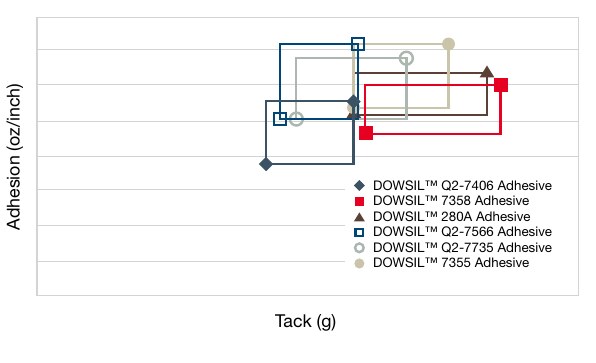
Adhesion vs. tack as a function of peroxide level, cure time and cure temperature
- Cure parameter range: 1.5–3.0% benzoyl peroxide
- 184–204°C cure temperature (70°C/2 min standard devolatilization temperature)
- 1.5–3 min cure time
Frequently asked questions
What is the bath life of platinum-cure silicone PSA after adding catalyst?
The 2024 Dow guide says to use the coating bath within six hours of catalyst addition (the 2006 guide stated 24 hours — always follow the current guide).
What peroxide level is used?
0.5 to 3.0 percent by weight of adhesive solids (benzoyl peroxide); higher levels lower tack and adhesive strength and raise cohesive strength.
Where can I get technical support for Dow silicone PSAs in Korea?
Korea Construction Trading (KCT) supports product selection, technical documents, process conditions and troubleshooting to the best of its ability: sales@kconstrade.com, +82 10-8939-0284.
This page is based on the following document. Values are typical, not specifications; verify with the original and product data sheets before design or purchase.
Dow, “Silicone PSAs for High Performance Selection Guide”, Form No. 30-1315-01-0524 S2D, © 2024 The Dow Chemical Company (2024 최신판); Dow Corning, “Product Selection and Application Guide — Dow Corning® brand High-Performance Silicone PSAs”, Form No. 30-083B-01 (AGP7825), ©2001, 2006 Dow Corning Corporation (2006 구판). 한국어 번역·정리: 한국건설트레이딩(KCT)
Suggested citation: “Processing and Curing Considerations (2024): Platinum and Peroxide Cure, Oven Dusting, Anchorage”, Korea Construction Trading (KCT) Technical Information, https://kconstrade.com/ja/technical/psa/processing-and-curing-2024
More technical resources
For DOWSIL™ silicone selection, quotations and technical advice, please contact Korea Construction Trading. We do our best to support you technically, from product selection to process-condition review and troubleshooting. Technical support details →
sales@kconstrade.com010-8939-0284WhatsApp