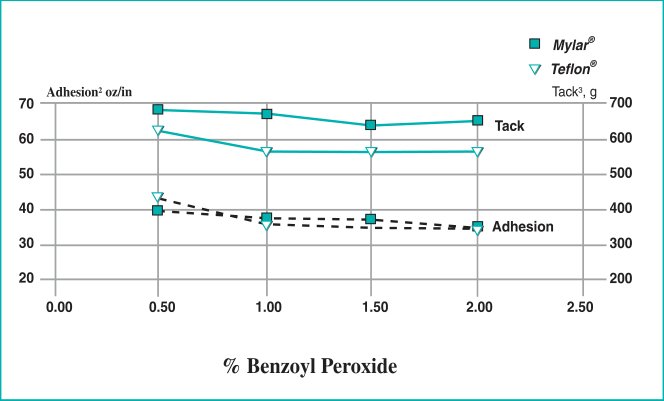
Peroxide concentration (benzoyl peroxide) can be varied from 0.5 to 3.0% of adhesive solids; more peroxide lowers tack and adhesion and raises cohesive strength. Use powdered 98% benzoyl peroxide as a 10% toluene solution and use the bath within a day. Cure in two steps: solvent removal at 65–93 °C (150–200 °F), then typically 1 minute at 66 °C followed by 2 minutes at 177–204 °C (350–400 °F).
Peroxide Cure
To achieve a good balance of tack, adhesive strength and cohesive strength over a wide range of operating temperatures, proper cure is essential. The catalyst most typically used with silicone PSAs is benzoyl peroxide. Peroxide concentration can be varied from 0.5 to 3.0 percent (based on adhesive solids). Increasing peroxide concentration will decrease the tack and adhesive strength of the cured coating, but will increase its cohesive strength (see Figure 6). The most consistent results are achieved by using the powdered, 98 percent benzoyl peroxide. Complete blending of peroxide and adhesive is best obtained by making a 10 percent solution of the peroxide in toluene. If a catalyst is added, the coating bath should be used within a day after mixing, as the peroxide loses its activity quite rapidly in solvent. Thorough dispersion of the adhesive and peroxide during mixing is necessary to achieve uniform results in the finished product.
Two-step cure: solvent removal and heat cure
Curing the adhesive is a two-step process that requires the use of graded temperatures.
Solvent removal
The first step in curing the adhesive, following its application to the backing material, is solvent removal. Recommended temperatures for solvent removal range from 65 to 93 °C (150 to 200 °F). Higher removal temperatures can cause the peroxide to decompose prematurely and crosslink the solvent into the adhesive. This can reduce the properties of the finished tape. The length of time for solvent removal should be sufficient to ensure that no solvent is present in the adhesive when it enters the curing zone.
Heat cure
After the solvent is removed, a tacky, uniform film of adhesive is left on the backing. This film’s adhesive and cohesive strengths, as well as the tack, can be further developed by a heat cure. The amount of cure depends on a number of factors, including the type of catalyst or equipment and backing material. A cure of 1 minute at 66 °C (150 °F) for solvent removal, followed by 2 minutes at 177 to 204 °C (350 to 400 °F) is typically used for adhesives that contain benzoyl peroxide. If equipment and type of backing material permit the use of higher curing temperatures, the cure time may be shortened. Higher cure temperatures develop cohesive strength of the adhesive in less time than at lower temperatures. The ultimate adhesive strength of the fully cured material is essentially the same whether cured at higher or lower temperatures. The only difference is the time required to reach complete cure.
Alternative cure options
Peroxide-cure silicone PSAs will develop basic PSA properties without the addition of a catalyst. Simple solvent removal followed by heat cure may be desirable for some low-temperature bonding applications. However, this procedure is not commonly used in the production of pressure sensitive adhesive tapes. Alternatively, a tin catalyst or a silane coupling agent, such as Dow Corning® Z-6020 Silane, may also be used. These options will produce a PSA that bonds well and offers good adhesive strength in low-temperature applications. However, the high-temperature performance of these materials will be inferior to those cured with peroxide and will continue to cure until dry.
Frequently asked questions
What peroxide level is used for silicone PSAs?
Benzoyl peroxide, 0.5–3.0% based on adhesive solids; higher levels lower tack and adhesive strength but raise cohesive strength.
What temperature should solvent be removed at?
65–93 °C (150–200 °F); higher temperatures can decompose the peroxide prematurely.
This page is based on the following document. Values are typical, not specifications; verify with the original and product data sheets before design or purchase.
Dow, “Silicone PSAs for High Performance Selection Guide”, Form No. 30-1315-01-0524 S2D, © 2024 The Dow Chemical Company (2024 최신판); Dow Corning, “Product Selection and Application Guide — Dow Corning® brand High-Performance Silicone PSAs”, Form No. 30-083B-01 (AGP7825), ©2001, 2006 Dow Corning Corporation (2006 구판). 한국어 번역·정리: 한국건설트레이딩(KCT)
Suggested citation: “Peroxide-Cure Process: Benzoyl Peroxide Level, Solvent Removal and Heat Cure (Figure 6)”, Korea Construction Trading (KCT) Technical Information, https://kconstrade.com/ja/technical/psa/peroxide-cure-process
More technical resources
For DOWSIL™ silicone selection, quotations and technical advice, please contact Korea Construction Trading. We do our best to support you technically, from product selection to process-condition review and troubleshooting. Technical support details →
sales@kconstrade.com010-8939-0284WhatsApp