
모래에서 실리콘까지
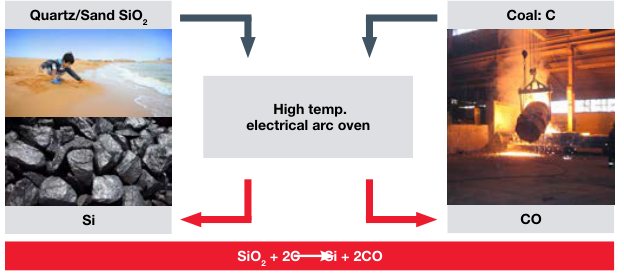
실리콘 생산에 필요한 주원료는 모래(SiO₂)입니다. 모래는 고온 전기 아크로에서 석탄을 이용해 금속 규소(silicon metal)로 환원됩니다.
English original
The main raw material needed for the production of silicone is sand (SiO₂). Sand is reduced to silicon metal in a high temperature electrical arc oven using coal.
English caption
Figure 3: From sand to silicon metal
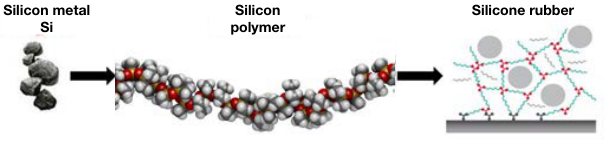
이후 금속 규소를 중합하여 폴리디메틸실록산(polydimethylsiloxane)을 얻습니다. 이 고분자는 Si-O 결합의 주쇄에 각 Si 원자마다 두 개의 메틸기가 붙은 구조입니다. 이 단위가 반복되어 길이와 점도가 서로 다른 고분자가 만들어집니다. 나선형 고분자 사슬의 말단은 고분자에 특정 성질을 부여하는 여러 종류의 작용기로 종결됩니다. 다음 단계에서 이 고분자에 기재에 대한 접착을 발현시키는 접착 증진제, 강도와 인열 저항 같은 기계적 물성을 부여하는 탄산칼슘(CaCO₃) 등의 충전제, 그리고 고분자 사슬을 3차원 구조로 연결하는 가교제 등을 배합하여 실란트로 제조하며, 이렇게 해서 실링 용도에 일반적으로 쓰이는 실리콘 고무가 만들어집니다.
English original
The silicon metal is subsequently polymerized to obtain polydimethylsiloxane, which has a backbone made of Si-O bonds with two methyl groups on each Si atom. This block is repeated to obtain polymers of different lengths and viscosity. The extremities of the helicoidal polymer chain are terminated with different types of functional groups which impart specific properties to the polymer. In a next step the polymer is formulated into a sealant, adding various elements such as adhesion promotors to develop adhesion on substrates, fillers such as calcium carbonate (CaCO₃) to provide mechanical properties such as strength and tear resistance and of course crosslinking elements to connect the polymer chains into a three-dimensional structure, to produce the silicone rubber typically used in sealing applications.
English caption
Figure 4: From silicon metal to silicone sealant (silicon metal → silicon polymer → silicone rubber)
화재 노출 시의 실리콘
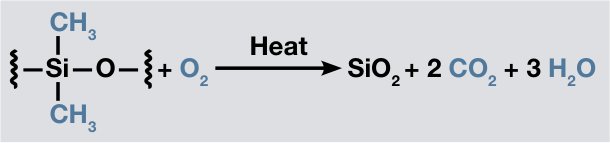
화재 중에 경화된 실리콘은 열과 산소에 동시에 노출됩니다. 그 결과 고분자 속의 규소 원자가 결국 원래의 원료인 실리카(SiO₂)로 재산화됩니다. 이는 열과 산소에 노출된 실리콘 위에 실리카 차르(silica char)가 형성되는 것으로 관찰할 수 있습니다. 카본 블랙 안료가 CO₂로 산화되기 때문에, 검은색 실리콘이라 하더라도 이 실리카 차르는 흰색을 띱니다. 이 반응의 부산물은 수증기입니다.
English original
During a fire, the cured silicone is exposed to a combination of heat and oxygen. This will eventually result in the re-oxidization of the silicon atom in the polymer into silica (SiO₂), the original raw material. This can be observed through the formation of a silica char on the silicone that has been exposed to heat and oxygen. This silica char will be white, even in the case of a black silicone, as the carbon black pigment will oxidize into CO₂. A by-product of this reaction is water vapor.
English caption
Figure 5: Molecular decomposition under fire exposure
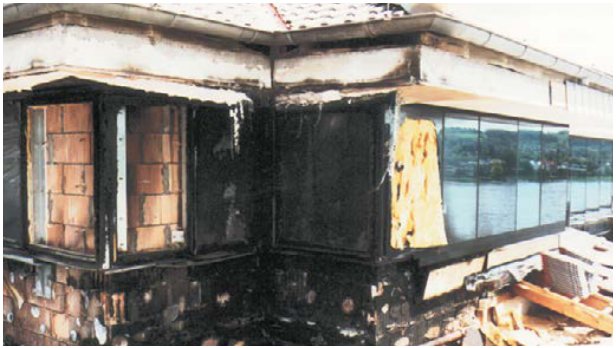
DOWSIL™ 실리콘 실란트의 우수한 성능은 실제 화재 사례에서 확인할 수 있습니다. 아래 이미지는 실리콘 접착 글레이징 유닛이 적용된 저층 주거 건물입니다. 건물 모서리에서 외부 화재가 시작되었으며, 이러한 유형의 화재는 600°C에 이를 수 있습니다. 글레이징 유닛은 열충격으로 깨졌지만 유리 파편은 알루미늄 프레임에 접착된 상태를 유지했습니다. 실리콘은 탄화되어 흰색 껍질이 관찰되었으며, 실리카 차르 아래에서 실리콘은 여전히 프레임에 대한 접착을 유지하고 있었습니다.
English original
The excellent performance of the DOWSIL™ Silicone Sealants can be observed in a real fire case. The images below show a low-rise residential building with silicone bonded glazed units. An external fire started in the corner of the building. This type of fire can reach 600°C. The glazed units broke due to the thermal shock but the glass shards remained bonded on the aluminium frame. The silicone charred and a white crust was observed. Underneath the silica char, the silicone still maintained adhesion to the frame.
English caption
Figure 6: Residential building using silicone bonded glazing after external fire. The silicone shows a silica char.
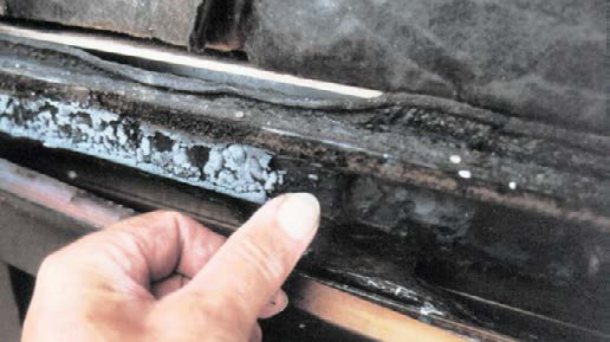
English caption
Close-up of the silica char on the silicone joint
다른 기술정보 자료
DOWSIL™ 내화 실란트 공급·견적·기술 문의는 아래로 연락해 주세요. 출처: Dow 기술 매뉴얼 (Form No. 62-2233-01-0325 S2D, © 2025 The Dow Chemical Company).
sales@kconstrade.comWhatsApp