
개요
내화 성능은 화재가 발달한 이후 그 확산을 제어하기 위한 것입니다. 적절한 수준의 내화 성능은 화재가 상층부와 인접 건물로 번지는 데 필요한 시간을 늘려 줍니다. 이는 화재로 인한 건물과 재산의 손실을 제한하고, 소방관의 거주자 대피를 돕고, 화재 진압의 효율을 높이는 데 도움이 됩니다.
English original
Fire resistance is intended to control the spread of fire once it has developed. Appropriate levels of fire resistance can increase the time needed for the fire to spread to higher floors and adjacent buildings. This can limit building and material loss from the fire, aid fire fighters in the evacuation of occupants and assist in the efficiency of fighting the fire.
건물은 일반적으로 화염, 연기, 열의 통과를 제한하고 인접한 실로의 화재 확산을 막기 위한 별개의 구획(compartment)으로 나뉩니다. 이 구획은 거주자가 안전하게 대피할 충분한 시간을 주고 소방관의 안전 여유를 높이도록 설계됩니다. 방화구획은 내화 벽, 바닥, 문으로 구성됩니다. 구획 벽과 바닥은 각 단위 사이에 완전한 차단벽을 형성하며 최소한의 내화 성능을 제공해야 합니다.
English original
Buildings are typically sub-divided into discrete compartments specifically intended to limit the passage of flames, smoke or heat and prevent the spread of fire to adjacent rooms. These compartments are designed to give occupants enough time to safely evacuate and increase safety margins for fire fighters. A fire compartment consists of fire-resistant walls, floors and doors. Compartment walls and floors form a complete barrier between each unit and are required to provide a minimum degree of fire resistance.
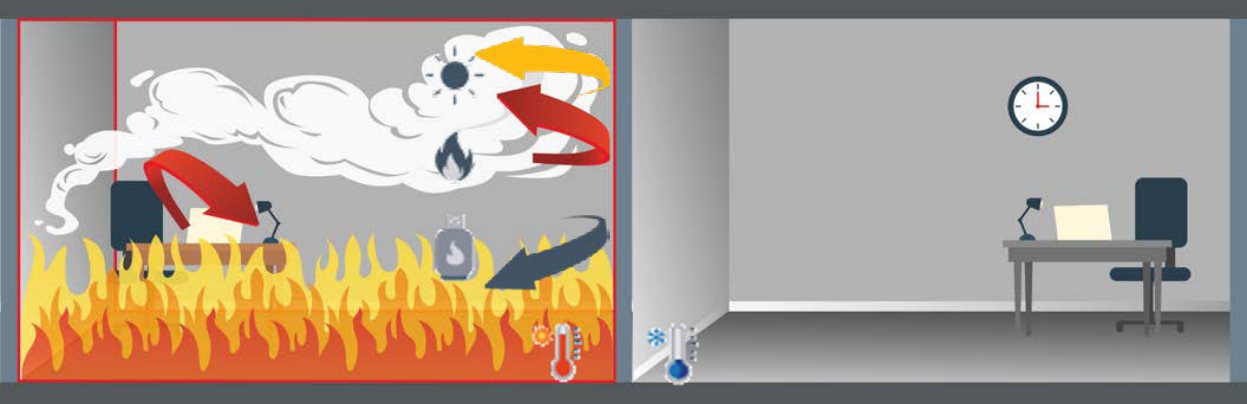
English caption
Figure 11: Compartmentation in buildings: fire rated walls and floors prevent the spread of fire (flames, hot gases and smoke) to adjacent rooms
방화 구획 부재 내부 및 부재 사이의 선형 줄눈과 개구부는 건축 구성 요소(벽, 바닥, 문, 창)의 내화 성능이 연속되도록, 그리고 인접한 건축 요소와 동일한 내화 등급을 달성할 수 있도록 내화(방염) 재료로 실링해야 합니다. 선형 줄눈은 화재 중 열에 의한 움직임(수축 또는 팽창)을 겪기 쉬우므로 완전한 기능을 유지해야 합니다. 이러한 선형 줄눈은 벽의 수평 또는 수직 줄눈, 벽과 벽 사이, 바닥과 바닥 사이, 또는 벽과 천장/바닥의 접합부에 나타날 수 있습니다.
English original
Linear joints and openings in and between fire-separating elements should be sealed with fire retardant materials to maintain the continuity of fire resistance of construction components (wall, floor, door, windows) and be able to achieve the same fire rating as adjacent building elements. The linear joints are prone to thermal movement (shrinking or expanding) during the fire and should stay fully functional. These linear joints can appear either as horizontal or vertical joints in a wall, between walls, between floors or at the connection wall to ceiling/floor.
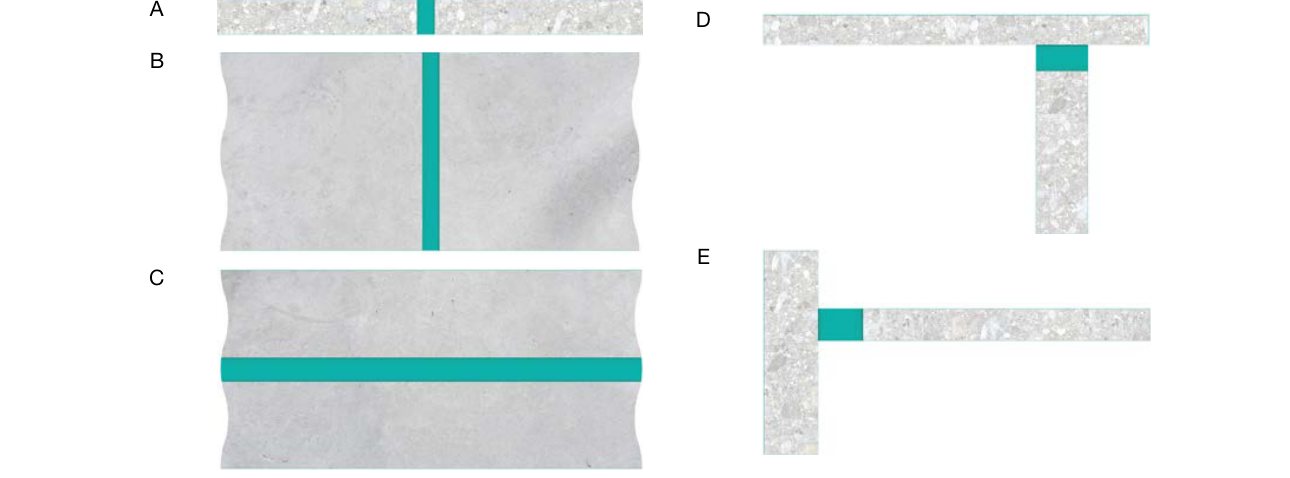
English caption
Figure 12: Possible linear joint applications between walls (A), in walls (B, C), between a wall abutting a ceiling (D) and a floor abutting a wall (E)
방화구획의 벽과 바닥에는 배관과 케이블이 통과하는 개구부도 있을 수 있습니다. 이러한 모든 개구부가 올바른 재료로 안전하게 밀봉되기 전에는 방화구획이 완성된 것이 아닙니다.
English original
The walls and floors of a fire compartment can also have openings through which pipes and cables are fed. A fire compartment is not complete until all these openings have been sealed safely using the correct materials.
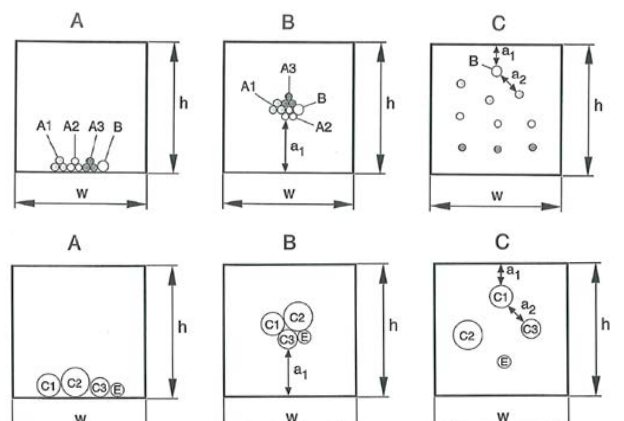
English caption
Figure 13: Illustration of different possible penetrant types (eg A1, A2, A3, B, C1, C2) and configurations. The opening’s dimensions (w,h), the distance from the penetrant to the edge of the opening (a1), the distance between different penetrants (a2) all influence the fire performance.
차염성(E)과 차열성(I)
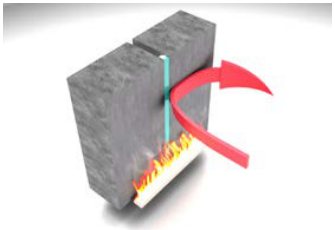
English caption
Figure 14: E – Integrity. Separation function: prevent the passage of flames and hot gases to the unexposed side
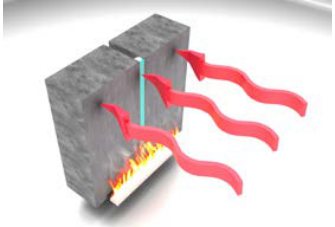
English caption
Figure 14: I – Insulation. Insulating function: prevent the increase of temperature on the non-exposed side
유럽에서 선형 줄눈과 관통부 실링의 내화 성능을 시험하고 분류하는 데 관련된 규격은 각각 EN1366 시험 규격(제3부, 제4부)과 EN13501-2 분류 규격입니다. 건축 부재는 밀폐된 실내의 화재를 모사하는 가스 가열로 안에서 시험됩니다. 평가 대상 부재는 벽 또는 바닥에 장착할 수 있으며, 가열로 내부 온도는 급격히 상승한 뒤 점차 완만해집니다. 가열로 내부의 열전대(온도 센서)는 시험 중 평균 온도가 올바른 곡선을 따르는지 감시하며, 시험 재료에 설치된 열전대는 그 온도 상승을 추적합니다. 이 시험은 실링의 차염성(E)과 차열성(I)을 평가합니다.
English original
In Europe, the relevant standard for testing and classifying the fire resistance of linear joints and penetration seals are respectively the EN1366 testing standard (part 3 and part 4) and the EN13501-2 classification standard. The construction elements are tested within a gas fired furnace which simulates a fire within an enclosed room. The evaluated elements can be mounted on a wall or a floor and the temperature within the furnace rises sharply then gradually starts to level out. Thermocouples (temperature sensors) within the furnace monitor the temperature during the test to ensure the average temperature follows the correct curve. Thermocouples on the tested material follow its temperature increase. The test will assess the integrity (E) and insulation (I) capacity of the seals.
차염성(E)은 분리 기능, 즉 건축 부재의 한쪽 면이 화재에 노출되었을 때 화염, 연기, 뜨거운 가스가 비가열면으로 통과하는 것을 막는 능력을 정의합니다. 차염성(E) 상실은 다음의 경우에 발생한 것으로 봅니다.
English original
The integrity (E) defines the separation function and hence the capability of a building element, when exposed to fire on one side, to prevent the passage of flames, smoke and hot gases to the unexposed side. The integrity (E) failure is deemed to occur:
- 부재가 붕괴하거나 비가열면에서 지속적인 화염(10초 초과)이 발생하는 경우
- 개구부가 생겨 화염이나 뜨거운 가스가 최대 30초간 적용한 면 패드(cotton fibre pad)를 발화 또는 작열시키는 경우
- 직경 6mm 틈새 게이지가 틈을 통해 가열로 안으로 관통하여 틈 안에서 150mm 이상 이동할 수 있는 경우
- 직경 25mm 틈새 게이지가 틈을 통해 가열로 안으로 관통할 수 있는 경우
English original
- when collapse or sustained flaming (more than 10s) on the unexposed face of the element occurs
- when openings form and allow flames or hot gases to cause flaming or glowing of a cotton fibre pad, when applied for a maximum of 30s
- when a 6mm diameter gap gauge can penetrate through a gap into the furnace and be moved in the gap for a distance of at least 150mm
- when a 25mm diameter gap gauge can penetrate through a gap into the furnace
열 차단 분리 기능(I)은 화재 시 건축 부재가 요구되는 단열 분리 기능을 유지하는 능력을 의미합니다. 차열성 상실은 다음의 경우에 발생한 것으로 봅니다.
English original
The thermal insulating separation function (I) describes the capability of a building element to maintain its required thermal insulation separating function in case of fire. Failure is deemed to occur:
- 비가열면의 평균 온도가 초기값보다 140°C 넘게 상승하는 경우
- 비가열면의 어느 위치(이동식 열전대 포함)에서든 기록된 온도가 초기 평균 비가열면 온도보다 180°C를 초과하는 경우
- 차염성이 상실되는 경우
English original
- when the mean unexposed face temperature increases by more than 140°C above its initial value
- when the temperature recorded at any position (including the roving thermocouple) on the unexposed face is in excess of 180°C above the initial mean unexposed face temperature
- when integrity failure occurs
180°C는 화염 반대편(비가열측)의 재료가 자연 발화하여 화재를 전파시키게 되는 한계 온도입니다. 차열성 상실 시간은 차염성 상실 시간을 초과할 수 없습니다. 차염성이나 차열성 상실이 발생하지 않으면, 합의된 가열 종료 시점까지의 시간이 결과가 됩니다. 줄눈이 화재를 견디며 차염성(E) 및/또는 차열성(I)을 유지한 시간(분 단위: 15, 20, 30 등)을 기준으로 등급이 부여됩니다. E와 I에 요구되는 등급은 건축 부재의 기능과 위치에 따라 달라집니다. 예를 들어 승강기 샤프트(화재 시 사용하지 않음)에서는 요건이 덜 엄격하고, 피난 경로나 계단에서는 더 엄격할 수 있습니다. 요건은 건물 내 실링의 위치뿐 아니라 건물이 위치한 국가의 요구사항에 따라서도 다를 수 있습니다. 프로젝트마다 요구되는 내화 성능을 확인할 것을 권장합니다.
English original
The 180°C temperature is the limit which will lead to spontaneous ignition of materials on the fire averted side and propagate fire. The period given for the insulation failure cannot exceed that for integrity failure. If no integrity or insulation failure occurs, then the result is the time up until the agreed end of the heating period. Based on the time expressed in minutes (15, 20, 30, etc.) during which the joints manage to resist the fire and maintain integrity (E) and/or thermal insulation (I) a classification is obtained. The required classification in E and I depend on the function and location of the building element. Requirements can be less severe for instance in case of an elevator cage (which will not be used in the event of a fire) and more severe on an escape route or stairs. Requirements may differ not only based on the location of the seal in the building, but also the location of the building may impose national requirements. It is recommended that the required performance in fire resistance be verified for each project.
시험 규격
어떤 시험이 필요한지는 제품의 적용 분야에 따라 다릅니다. 시험 규격 EN1366-4는 선형 줄눈 용도에, EN1366-3은 관통부 실링에 적용됩니다. BS476-20은 EN1366 시리즈보다 앞서 제정되어 건축 부재의 내화 성능 평가에 대한 일반 원칙을 규정하며, 제22부는 비내력(non-load bearing) 건축 부재의 시험 세부사항을 다룹니다. 이 규격들은 부재의 내력, 화염 차단(차염성), 열 전달(차열성)을 평가할 수 있는 명확한 기준을 제공합니다. 이 매뉴얼 작성 시점에, BS476 시리즈에 따라 얻은 시험 결과는 유럽 안팎의 여러 나라에서 여전히 유효하며 인정되고 있습니다. 과거 BS476-20에 따라 평가된 재료는 (예를 들어 다른 구성으로) 계속해서 BS476 시리즈에 따라 평가될 것으로 일반적으로 받아들여집니다. 새로 개발된 재료는 일반적으로 EN1366 시리즈에 따라 시험됩니다. 선형 줄눈에 대한 UL 규격은 UL2079이며, 관통부 실링의 유효한 기준은 UL1479에 규정되어 있습니다. UL 외에도 ASTM은 고압 호스 스트림(hose stream) 시험을 포함하는 관통부 실링 시험 규격인 ASTM E814(관통 파이어스톱 시스템 화재 시험 표준 방법)와, 선형 줄눈용 ASTM E1966을 제공합니다.
English original
Which testing is needed specifically, depends on the product’s area of application. Test standard EN1366-4 is relevant for linear joint applications. For penetration seals, the standard EN1366-3 is applicable. The BS476-20 preceded the EN1366 series and sets out the general principles for assessing the fire resistance of construction elements with part 22 addressing the testing specificities for non-load bearing construction elements. These standards provide clear criteria by which an element’s loadbearing capacity, fire containment (integrity) and the thermal transmittance (insulation) can be assessed. At the time of writing this manual, the test results obtained according to this BS476 standard series are still valid and accepted in various countries, both in and outside of Europe. It is generally accepted that materials, which have been evaluated in the past according to the BS476-20, will continue to be evaluated according to the BS476 series of standards (for instance in different configurations). Newly developed materials will typically be tested according to the EN1366 standard series. The UL equivalent for linear joints is UL2079, whilst the valid reference for penetration seals is described by UL1479. Besides UL, ASTM also provides ASTM E814 (Standard Test Method for Fire Tests of Penetration Firestop Systems) as testing standard for penetration seals which includes a high pressure hose stream test, and ASTM E1966 for linear joints.
| 제품군 | 구분 | EU 규격 | 영국 규격 | 북미 요건 |
|---|---|---|---|---|
| 파이어스톱 | 관통부 실링 | EN 1366-3 | BS476-20/22 | UL 1479, ASTM E814 |
| – | 선형 줄눈 및 틈새 실링 | EN 1366-4 | BS476-20/22 | UL 2079, ASTM E1966 |
추가적인 지역/국가별 시험 결과도 있습니다. 이 시험 성적서에 관한 자세한 내용은 현지 Dow 기술 전문가에게 문의하십시오.
English original
Additional specific (local/national) test results are available. Please contact your local Dow Technical Specialist for more information related to these reports.
다른 기술정보 자료
DOWSIL™ 내화 실란트 공급·견적·기술 문의는 아래로 연락해 주세요. 출처: Dow 기술 매뉴얼 (Form No. 62-2233-01-0325 S2D, © 2025 The Dow Chemical Company).
sales@kconstrade.comWhatsApp