과산화벤조일 농도는 접착제 고형분 기준 0.5~3.0%로 조절할 수 있으며, 농도가 높을수록 택과 접착 강도는 낮아지고 응집력은 높아집니다. 분말 98% 과산화벤조일을 톨루엔 10% 용액으로 만들어 사용하고 배스는 하루 이내에 사용합니다. 경화는 65~93 °C(150~200 °F) 용제 제거 후 보통 66 °C 1분 → 177~204 °C(350~400 °F) 2분의 2단계로 진행합니다.
과산화물 경화
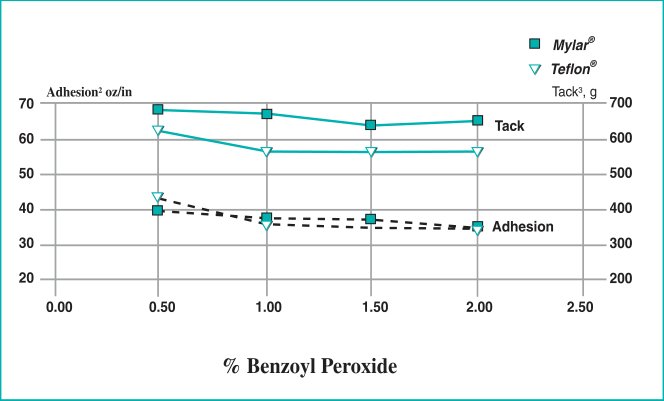
넓은 사용 온도 범위에서 택·접착 강도·응집력의 균형을 얻으려면 올바른 경화가 필수입니다. 실리콘 PSA에 가장 일반적으로 쓰이는 촉매는 과산화벤조일입니다. 과산화물 농도는 접착제 고형분 기준 0.5~3.0%로 조절할 수 있으며, 농도를 높이면 경화 도막의 택과 접착 강도는 낮아지고 응집력은 높아집니다(그림 6). 가장 일관된 결과는 분말 98% 과산화벤조일로 얻어지며, 과산화물과 접착제의 완전한 혼합은 톨루엔에 과산화물 10% 용액을 만들어 사용하는 것이 가장 좋습니다. 촉매를 첨가한 경우 과산화물은 용제 속에서 활성이 빠르게 감소하므로 혼합 후 하루 이내에 코팅 배스를 사용해야 합니다. 최종 제품의 균일성을 위해 혼합 시 접착제와 과산화물을 충분히 분산시켜야 합니다.
English original
To achieve a good balance of tack, adhesive strength and cohesive strength over a wide range of operating temperatures, proper cure is essential. The catalyst most typically used with silicone PSAs is benzoyl peroxide. Peroxide concentration can be varied from 0.5 to 3.0 percent (based on adhesive solids). Increasing peroxide concentration will decrease the tack and adhesive strength of the cured coating, but will increase its cohesive strength (see Figure 6). The most consistent results are achieved by using the powdered, 98 percent benzoyl peroxide. Complete blending of peroxide and adhesive is best obtained by making a 10 percent solution of the peroxide in toluene. If a catalyst is added, the coating bath should be used within a day after mixing, as the peroxide loses its activity quite rapidly in solvent. Thorough dispersion of the adhesive and peroxide during mixing is necessary to achieve uniform results in the finished product.
English caption
Figure 6. Effect of peroxide level on adhesion and tack. Tapes made from 280A Adhesive; adhesive thickness 1.5 mil; cure: 1 minute at 65 °C (150 °F) followed by 2 minutes at 177 °C (350 °F) for Mylar®, 2 minutes at 204 °C (400 °F) for Teflon®; adhesion per PSTC-1; Polyken® tack: 0.5 s dwell, 0.5 cm/s draw speed.
2단계 경화 — 용제 제거와 열 경화
접착제 경화는 구배 온도를 사용하는 2단계 공정입니다.
English original
Curing the adhesive is a two-step process that requires the use of graded temperatures.
용제 제거
기재에 도포한 뒤 첫 단계는 용제 제거입니다. 권장 용제 제거 온도는 65~93 °C(150~200 °F)입니다. 더 높은 온도에서는 과산화물이 조기 분해되어 용제가 접착제에 가교될 수 있고, 이는 완제품 테이프의 물성을 저하시킵니다. 용제 제거 시간은 경화 구역에 들어갈 때 접착제 내에 용제가 남지 않도록 충분해야 합니다.
English original
The first step in curing the adhesive, following its application to the backing material, is solvent removal. Recommended temperatures for solvent removal range from 65 to 93 °C (150 to 200 °F). Higher removal temperatures can cause the peroxide to decompose prematurely and crosslink the solvent into the adhesive. This can reduce the properties of the finished tape. The length of time for solvent removal should be sufficient to ensure that no solvent is present in the adhesive when it enters the curing zone.
열 경화
용제가 제거되면 기재 위에 끈적하고 균일한 접착 필름이 남습니다. 이 필름의 접착 강도, 응집력, 택은 열 경화로 더 발현시킬 수 있습니다. 경화 정도는 촉매·설비·기재 종류 등 여러 요인에 따라 달라집니다. 과산화벤조일을 함유한 접착제에는 보통 66 °C(150 °F) 1분(용제 제거) 후 177~204 °C(350~400 °F) 2분 경화를 사용합니다. 설비와 기재가 더 높은 경화 온도를 허용하면 경화 시간을 단축할 수 있습니다. 높은 온도는 낮은 온도보다 짧은 시간에 응집력을 발현시키며, 완전 경화된 재료의 최종 접착 강도는 경화 온도에 관계없이 본질적으로 같고 완전 경화에 필요한 시간만 다릅니다.
English original
After the solvent is removed, a tacky, uniform film of adhesive is left on the backing. This film’s adhesive and cohesive strengths, as well as the tack, can be further developed by a heat cure. The amount of cure depends on a number of factors, including the type of catalyst or equipment and backing material. A cure of 1 minute at 66 °C (150 °F) for solvent removal, followed by 2 minutes at 177 to 204 °C (350 to 400 °F) is typically used for adhesives that contain benzoyl peroxide. If equipment and type of backing material permit the use of higher curing temperatures, the cure time may be shortened. Higher cure temperatures develop cohesive strength of the adhesive in less time than at lower temperatures. The ultimate adhesive strength of the fully cured material is essentially the same whether cured at higher or lower temperatures. The only difference is the time required to reach complete cure.
대체 경화 방법
과산화물 경화 실리콘 PSA는 촉매를 첨가하지 않아도 기본적인 PSA 특성을 발현합니다. 일부 저온 접착 용도에서는 용제 제거 후 열 경화만 하는 방법이 바람직할 수 있으나, 감압 접착 테이프 생산에는 일반적으로 사용되지 않습니다. 대안으로 주석 촉매나 Dow Corning® Z-6020 실란 같은 실란 커플링제를 사용할 수 있으며, 이 경우 저온 용도에서 접착이 좋고 접착 강도가 우수한 PSA가 되지만 고온 성능은 과산화물 경화품보다 떨어지고 건조될 때까지 계속 경화됩니다.
English original
Peroxide-cure silicone PSAs will develop basic PSA properties without the addition of a catalyst. Simple solvent removal followed by heat cure may be desirable for some low-temperature bonding applications. However, this procedure is not commonly used in the production of pressure sensitive adhesive tapes. Alternatively, a tin catalyst or a silane coupling agent, such as Dow Corning® Z-6020 Silane, may also be used. These options will produce a PSA that bonds well and offers good adhesive strength in low-temperature applications. However, the high-temperature performance of these materials will be inferior to those cured with peroxide and will continue to cure until dry.
자주 묻는 질문
실리콘 PSA에 쓰는 과산화물 농도는?
접착제 고형분 기준 과산화벤조일 0.5~3.0%이며, 높을수록 택·접착 강도는 낮아지고 응집력은 높아집니다.
용제 제거 온도는?
65~93 °C(150~200 °F)이며 더 높으면 과산화물이 조기 분해될 수 있습니다.
이 페이지는 다음 문서를 바탕으로 정리했습니다. 수치는 대표 값이며 시방 값이 아니므로 설계·구매 전에 원문과 제품 데이터 시트를 확인하십시오.
Dow, “Silicone PSAs for High Performance Selection Guide”, Form No. 30-1315-01-0524 S2D, © 2024 The Dow Chemical Company (2024 최신판); Dow Corning, “Product Selection and Application Guide — Dow Corning® brand High-Performance Silicone PSAs”, Form No. 30-083B-01 (AGP7825), ©2001, 2006 Dow Corning Corporation (2006 구판). 한국어 번역·정리: 한국건설트레이딩(KCT)
인용 예시: “과산화물 경화 공정 – 과산화벤조일 농도, 용제 제거, 열 경화 (그림 6)”, 한국건설트레이딩(KCT) 기술정보, https://kconstrade.com/ko/technical/psa/peroxide-cure-process
다른 기술정보 자료
DOWSIL™ 실리콘 제품 선정, 견적, 기술 상담은 한국건설트레이딩으로 문의해 주십시오. 한국건설트레이딩은 제품 선정부터 공정 조건 검토와 문제 해결까지 기술 지원을 위해 최선을 다하겠습니다. 기술 지원 안내 →
sales@kconstrade.com010-8939-0284WhatsApp