Silicone offers low surface energy, hydrophobicity, high gas permeability, excellent weathering (no UV absorption), thermal stability, chemical and physiological inertness, electrical insulation and oxidation/ozone resistance. Weaknesses: poor compatibility with organic polymers, attack by strong acids/alkalis, weak corrosion protection when coated, difficult adhesion to other materials and lower tensile/tear strength than organic rubber.
II. 2. Chemical and physical properties
실리콘은 다른 고분자 재료에 비해 다음과 같은 특성을 가지고 있다.
- 고분산성, 낮은 표면 에너지 및 표면 장력: CH3 기, Si-O 결합의 자유로운 회전에 기인함. 실리콘은 그 보다 낮은 표면 장력을 갖는 계면에 분산성이 우수. 표면을 완전히 둘러싸고, 탁월한 분산성을 가짐.
- 소수성: 표면을 둘러싼 소수성의 CH3에 기인.
- 높은 공기 투과성: Si-O 결합의 긴 길이와 자유로운 회전, 높은 공기 투과성은 Si-O의 강한 결합력과는 관련이 없음.
- 우수한 내후성: UV를 흡수하지 않음.
- 열적안정성 - 내열성, 내한성, 낮은 Tg, Tm.
- 높은 Flash Point.
- 낮은 극성, 비자극성, 화학적, 생리학적 불활성.
- 낮은 증발열 - Si 금속 때문.
- 내산화성, 내오존성.
- 전기 절연성, 낮은 전기전도성.
- 유동성, 유연성.
- 수증기, 공기 투과성.
- 높은 압축성.
단점
- 일반적으로 타 유기 고분자와의 상용성이 좋지 않음
- 강산과, 강알카리에 의해 분해될 수 있음
- 코팅시 방청성이 약함
- 타물질과의 접착이 어려움
- 유기 고무와 비교시 인장 강도, 인열 강도가 낮음
Characteristics by functional group
| Functional group | Position | Reactive | Function (property imparted) |
|---|---|---|---|
| Phenyl | R′ | No | Heat resistance |
| Fluoro | R′ | No | Chemical resistance |
| Amino | R or R′ | Yes | Softness |
| Methoxy | R | Yes | Durability, crosslinker |
| Acetoxy / Hydroxyl | R | Yes | RTV crosslinker |
| Glycol (Carbinol) | R or R′ | Yes / No | Water solubility, surfactant / lubricant |
| Vinyl | R | Yes | LSR base |
| Hydrogen | R′ | Yes | Water repellency, crosslinker |
| Alkyl | R′ | No | Good compatibility with organic polymers |
| Aryl | R′ | No | Good compatibility with organic polymers |
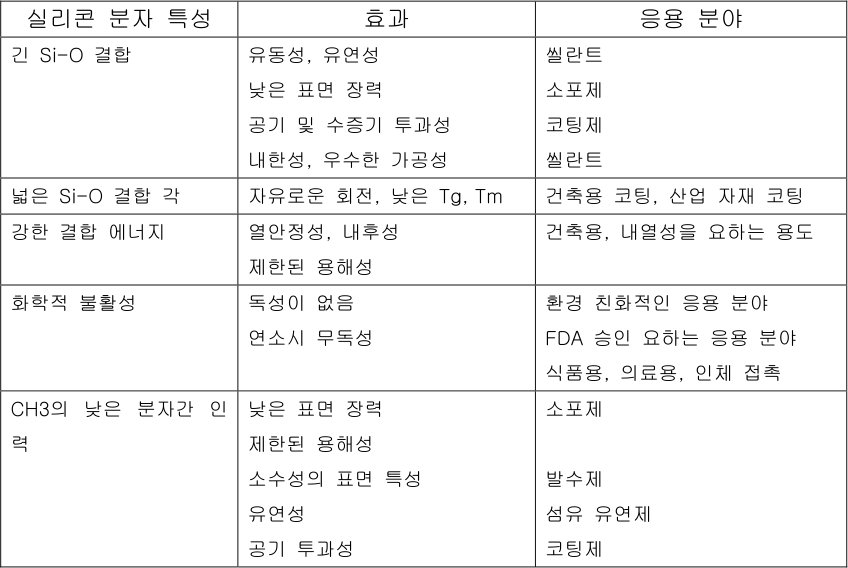
Molecular characteristics → effect → application
| Molecular characteristic | Effect | Application |
|---|---|---|
| Long Si–O bond | Fluidity, flexibility; low surface tension; air and water-vapour permeability; cold resistance, good processability | Sealant; antifoam; coating; sealant |
| Wide Si–O bond angle | Free rotation, low Tg, Tm | Architectural coatings, industrial coatings |
| Strong bond energy | Thermal stability, weatherability; limited solubility | Construction; uses requiring heat resistance |
| Chemical inertness | Non-toxic; non-toxic on combustion | Environmentally friendly uses; FDA-approved uses — food, medical, skin contact |
| Low intermolecular force of CH₃ | Low surface tension, limited solubility; hydrophobic surface; flexibility; air permeability | Antifoam; water repellent; fabric softener; coating |
Frequently asked questions
What are the main disadvantages of silicone?
Poor compatibility with other organic polymers, decomposition by strong acids and alkalis, weak corrosion protection when coated, difficult adhesion to other substances, and lower tensile and tear strength than organic rubber.
Which functional group gives heat resistance and which chemical resistance?
Phenyl gives heat resistance; fluoro gives chemical resistance (both non-reactive, side-chain positions).
This page is based on the following document. Values are typical, not specifications; verify with the original and product data sheets before design or purchase.
다우코닝 실리콘 교육자료 「제 2 장 실리콘 일반」(한국어, 23쪽) — Dow Corning Korea / 한국어 원문 수록 및 영어 번역: 한국건설트레이딩(KCT) / 보충: 공개 문헌 (아래 참고 자료 페이지)
Suggested citation: “Chemical and Physical Properties and Functional Groups of Silicone”, Korea Construction Trading (KCT) Technical Information, https://kconstrade.com/ja/technical/basics/properties-and-functional-groups
More technical resources
For DOWSIL™ silicone selection, quotations and technical advice, please contact Korea Construction Trading. We do our best to support you technically, from product selection to process-condition review and troubleshooting. Technical support details →
sales@kconstrade.com010-8939-0284WhatsApp